

What does carpal tunnel release involve?
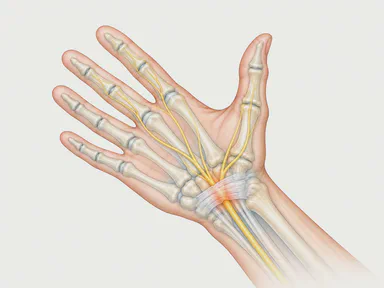
Carpal tunnel release is the procedure that treats carpal tunnel syndrome, compression of the median nerve as it passes through the wrist. The carpal tunnel is bounded by the carpal bones at the base and by the transverse carpal ligament at the roof. When the space narrows, the nerve is compressed and tingling, night-time pain, clumsiness and, over time, loss of sensation and strength appear.
Surgery consists of dividing the transverse ligament to widen the tunnel and give the nerve space. It is one of the most frequent procedures in hand surgery and forms part of peripheral nerve surgery. The aim is to decompress the nerve, halt its deterioration and promote recovery of sensation and function.
When is it indicated?
Surgery is not the first step. In mild or short-lived cases, a night splint, adapting activities and, where appropriate, a corticosteroid injection are tried first. Release is considered when:
- symptoms are daily or repeatedly wake the person at night;
- conservative treatment has not given stable relief;
- there is loss of strength, wasting of the muscle at the base of the thumb, or loss of sensation;
- the electromyogram shows moderate or severe compression.
In these situations, delaying surgery can make nerve damage harder to recover from. Carpal tunnel syndrome related to pregnancy, by contrast, tends to improve after delivery and is rarely operated on.
Before the procedure
Before surgery, the progress of symptoms, examination of sensation and strength, and the available tests are reviewed. The electromyogram confirms that compression of the median nerve is the source of the problem and grades its severity, which helps to anticipate the pace of recovery. Ultrasound can provide information on the thickness of the nerve and rule out other causes, such as a cyst or tenosynovitis.
Other problems causing similar symptoms, such as nerve compression in the neck or an ulnar neuropathy, are also ruled out. As the procedure is usually carried out under local anaesthesia, fasting is not necessary, nor is it necessary to stop most treatments, but it is worth reporting the medication you take, particularly anticoagulants.
How is it carried out?
Carpal tunnel release is carried out as day-case surgery, usually under local anaesthesia infiltrated into the palm and wrist, with or without sedation, or under regional anaesthesia of the arm if preferred. With the WALANT technique, which uses local anaesthetic with adrenaline, a tourniquet is not necessary, making the procedure more comfortable.
With the open technique, an incision of a few centimetres is made in the palm, in line with the ring finger; the transverse ligament is identified and divided along its full length under direct vision, checking that the nerve is free. Techniques with smaller incisions or endoscopic techniques also exist; the choice depends on the anatomy, the surgeon’s experience and the features of each case, and is discussed at the consultation.
The skin is closed with a few stitches and a light bandage is applied, leaving the fingers free. The procedure is short and you go home the same day.
Recovery and follow-up
The fingers are mobilised from the first day and the hand is kept elevated to reduce swelling. Dressings are changed periodically until the stitches are removed, at around two weeks. Light activities are resumed within a few days; return to work depends on the type of task, quicker for office work and slower for manual or heavy work.
Night-time tingling tends to improve soon. The scar can be tender for a few weeks, and it is common to notice discomfort when resting on the palm or using force, which eases gradually. Grip strength recovers over the following weeks. In long-standing compressions, recovery of sensation can be slower or incomplete. Follow-up at the consultation allows the return to activity to be adjusted and any questions about the scar or sensation to be resolved.
Risks and limitations
This is surgery with infrequent complications, but it is not without risk: infection, haematoma, a painful or hypersensitive scar, discomfort at the base of the palm when resting on it, temporary stiffness and, exceptionally, injury to a branch of the median nerve or the nerve itself. Incomplete division of the ligament can leave symptoms persisting.
As for its limits, surgery decompresses the nerve but cannot guarantee a full recovery of sensation or strength when the compression has been prolonged or severe. If the symptoms have another associated cause, such as cervical compression or a diabetic neuropathy, improvement can be partial. These expectations are explained individually before deciding on the procedure.
Specialist in carpal tunnel release in Barcelona
Dr Marta Martí Puente is a specialist in Orthopaedic Surgery and Traumatology with a focus on hand surgery and the peripheral nerves. At her consultation in Barcelona she assesses each case of carpal tunnel syndrome, proposes conservative treatment when appropriate and, when surgery is indicated, explains the technique and the recovery process on a personalised basis.
Frequently asked questions
Is carpal tunnel surgery done under local anaesthesia?
When will I be able to use my hand?
Does the tingling disappear as soon as I am operated on?
Can carpal tunnel syndrome come back after surgery?
Related conditions
Sources and references
The information on this page is general and educational. It does not replace an individual medical assessment.
