

What does minimally invasive hand and wrist surgery involve?
Minimally invasive surgery is not a single technique, but a way of approaching the procedure: achieving the same surgical goal with as little disruption to the tissues as possible, the simplest anaesthesia that remains safe, and a quicker recovery. In the hand and wrist, this translates into several tools that can be combined:
- local anaesthesia, and in particular the WALANT technique (Wide-Awake Local Anaesthesia No Tourniquet), which avoids sedation, fasting and a tourniquet;
- small incisions, sized to what needs to be seen and treated;
- percutaneous techniques, in which the procedure is carried out through a puncture, with or without ultrasound guidance;
- wrist arthroscopy, which allows work inside the joint through portals a few millimetres long;
- day-case regime, going home the same day.
It is a common way of working in current hand surgery, whenever the injury allows it.
When is it indicated?
Many of the most frequent hand procedures are well suited to this approach:
- carpal tunnel release, through a short incision in the palm under local anaesthesia;
- trigger finger surgery, with a small incision or percutaneously;
- release of the first extensor compartment in De Quervain’s tenosynovitis;
- removal of a ganglion cyst, open with a limited incision or by arthroscopy;
- needle fasciotomy in some cases of Dupuytren’s disease;
- certain techniques in thumb base arthritis, such as arthroscopy or denervation, in selected cases;
- percutaneous fixation with wires or screws for some fractures;
- diagnostic and therapeutic wrist arthroscopy.
As with any surgery, it is proposed after conservative treatment has been assessed, and only when there is a clear indication. Being minimally invasive does not make it an option that should be brought forward.
Before the procedure
The assessment is the same as for any procedure: clinical history, examination and the tests needed to confirm the diagnosis. What changes is the planning of the anaesthesia and the care pathway. With local anaesthesia, fasting is not necessary, nor is it necessary to stop most regular medication, although you should report the medication you take, any allergies and conditions such as diabetes or circulation problems in the fingers, which influence the choice of technique.
At the consultation, what will be done, what you will notice during the procedure and what the post-operative period will be like are explained. If you would prefer not to be awake, or if the procedure requires it, regional anaesthesia with sedation is offered.
How is it carried out?
In a procedure under WALANT, local anaesthetic with adrenaline is infiltrated into the area to be operated on a few minutes before starting. The adrenaline reduces bleeding, which makes a tourniquet unnecessary, this being the most uncomfortable part of surgery under conventional local anaesthesia. During surgery you are awake and can talk with the team. In some procedures, such as releasing a tendon or a tenolysis, you are asked to move your fingers to confirm, in the operating theatre itself, that the problem has been resolved.
Incisions are placed within the skin creases whenever possible and limited to the length needed to see the structures clearly. In percutaneous techniques, there is no incision as such: a needle or a fine instrument is introduced through the skin, sometimes guided by ultrasound, to divide a pulley, release a Dupuytren’s cord or fix a fracture.
At the end, a dressing or a light splint is applied and, after a brief period of observation, you go home the same day.
Recovery and follow-up
Most people start moving their fingers the same day and resume basic activities within a few days, depending on the procedure. Dressing changes are simple and the stitches, when present, are removed at the consultation after one or two weeks. Return to work depends on the activity: office tasks are resumed soon, while manual work or heavy lifting needs more time.
Full recovery, including strength, follows the same biological timescales as conventional surgery, because the tissues need the same amount of time to heal. What is reduced is the discomfort of the first few days and the time to regain independence. Follow-up appointments are scheduled in the same way as for any other procedure.
Risks and limitations
The general risks of hand surgery do not disappear because the technique is less disruptive: infection, haematoma, a tender scar, stiffness or injury to small nerve branches remain possible. In percutaneous techniques, since the structures are not seen directly, there is a specific risk of incomplete release or of injury to a nearby tendon or nerve, which is why they are reserved for cases with favourable anatomy.
The main limitation is the indication. Not every case can be operated on this way: complex fractures, extensive reconstructions, injuries to several structures or lengthy procedures require open approaches and a different type of anaesthesia. The technique is chosen according to the injury and the person, and a smaller incision should never come at the cost of the safety of the procedure.
Minimally invasive surgery in Barcelona
Dr Marta Martí Puente is a specialist in Orthopaedic Surgery and Traumatology with a focus on hand surgery and the wrist. At her consultation in Barcelona she explains, in each case, whether a minimally invasive approach or local anaesthesia is possible, and what its advantages and limits are compared with conventional surgery.
Frequently asked questions
What does WALANT mean?
Will I feel pain if I am awake during the operation?
Can all hand surgery be done in a minimally invasive way?
Does a small incision heal better?
Related conditions
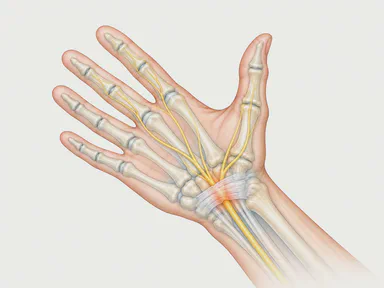
- Carpal tunnel Night-time tingling, numbness in the fingers and loss of strength caused by compression of the median nerve at the wrist.
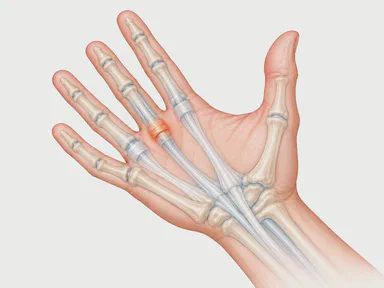
- Trigger finger Clicking, catching or locking of the finger when bending and straightening it, sometimes with a small painful lump in the palm.
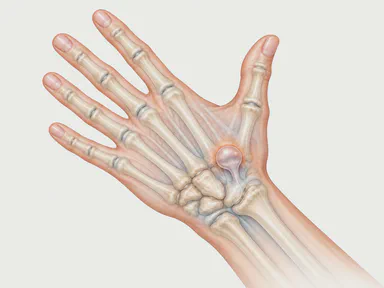
- Ganglion cyst A soft, benign, fluid-filled lump that arises from a joint or a tendon sheath, most often on the back of the wrist.
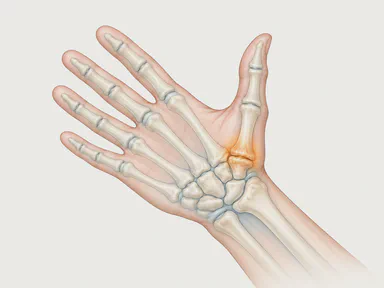
- Thumb base arthritis Pain and loss of strength at the base of the thumb caused by wear of the trapeziometacarpal joint.
- Dupuytren's Progressive thickening of the fascia of the palm that forms nodules and cords and eventually bends the fingers towards the palm.
Sources and references
The information on this page is general and educational. It does not replace an individual medical assessment.
