

What does surgery for Dupuytren’s disease involve?
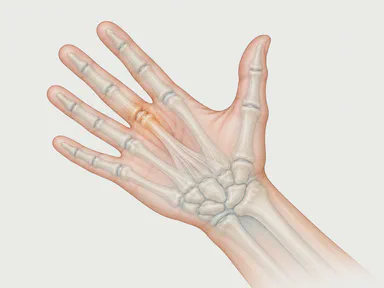
Dupuytren’s disease is a thickening of the palmar fascia, the layer of tissue beneath the skin of the palm. Over time, this tissue forms nodules and cords that pull the fingers towards the palm, particularly the ring and little fingers, preventing them from fully straightening. It is not an injury to the tendons, although the result, a finger that will not straighten, can look similar.
Dupuytren’s surgery aims to restore finger extension by removing or dividing the cords that pull them inward. Several techniques exist, from fasciectomy, which removes the diseased tissue, to needle fasciotomy, which divides it percutaneously. Neither cures the disease, which is a tendency of the tissue itself, but both correct the contracture and improve hand function. It is a common procedure in hand surgery.
When is it indicated?
Not every palmar nodule requires treatment. Many people live with a nodule or a mild cord without any limitation, and in these cases follow-up alone is enough. Treatment is considered when:
- the contracture progresses and it is no longer possible to lay the hand flat on a table;
- bending of the metacarpophalangeal joint, at the base of the finger, or the proximal interphalangeal joint, in the middle, interferes with everyday actions such as putting on gloves, washing the face, putting a hand in a pocket or gripping objects;
- the contracture affects work activity or hobbies.
Contracture of the proximal interphalangeal joint tends to become stiff over time and is harder to correct, so it is not advisable to wait too long when it progresses. There is no conservative treatment that halts the disease: splints and stretching do not prevent the contracture, although they are used after surgery.
Before the procedure
At the consultation, which fingers are affected, how many degrees of fixed flexion exist at each joint, whether the skin is adherent to the cord and whether there has been previous surgery are assessed. With this information, the most suitable technique is chosen: well-defined cords beneath healthy skin are suited to needle fasciotomy, while more complex contractures, with involvement of the interphalangeal joint or adherent skin, usually require fasciectomy.
Factors that influence progression, such as the age of onset, involvement of both hands or a family history, are also discussed, and expectations are explained: what correction can be expected, how long recovery will take and how likely recurrence is.
How is it carried out?
- Fasciectomy: through a zigzag incision in the palm and finger, the diseased tissue is identified and removed while protecting the digital nerves and arteries, which are frequently displaced or wrapped by the cord. If the skin is insufficient, a skin graft can be used. It is carried out under regional or local anaesthesia, as day-case surgery.
- Needle fasciotomy: under local anaesthesia, the cord is divided at several points with the bevel of a needle, through the skin, and the finger is straightened. It is a quick procedure, without an incision, within the minimally invasive surgery approach, but it does not remove the tissue and the contracture returns sooner.
- Collagenase: this is an injection of an enzyme that weakens the cord so it can be snapped the following day by manipulation at the consultation. Its availability varies by country and centre, and not every case is suitable, so it is discussed individually.
In long-standing contractures of the proximal interphalangeal joint, it is sometimes necessary to also release the joint itself.
Recovery and follow-up
After a fasciectomy, a bulky dressing is applied and the hand is kept elevated. Dressings are changed every few days until the stitches are removed, at around two weeks. Mobilisation of the fingers starts soon and is accompanied by rehabilitation with a hand therapist to control swelling, work on the scar and regain extension and flexion. A night splint is often used for a few weeks or months to maintain the correction. Full recovery usually takes several weeks and the scar takes months to mature.
After a needle fasciotomy, recovery is much shorter: the hand can be used for light activities within a few days, with a supporting night splint.
Follow-up allows a new contracture to be detected early and, if necessary, the right time for a further procedure to be decided.
Risks and limitations
The risks of fasciectomy include infection, problems with skin healing, haematoma, stiffness, injury to a digital nerve with loss of sensation in the finger, injury to a digital artery and, rarely, complex regional pain syndrome. In needle fasciotomy, skin tearing and injury to a nerve or a flexor tendon are possible.
The most important limitation is recurrence. Surgery corrects the contracture, but the disease can reappear in the same area or elsewhere, and this is more frequent with percutaneous techniques, in younger people and in aggressive forms. Correction of a long-standing stiff proximal interphalangeal joint is usually partial. And a further procedure on an area that has already been operated on is technically more difficult. These points are explained clearly before deciding on treatment.
Specialist in Dupuytren’s surgery in Barcelona
Dr Marta Martí Puente is a specialist in Orthopaedic Surgery and Traumatology with a focus on hand surgery. At her consultation in Barcelona she assesses the degree of contracture and its impact on function, explains the different treatment options and their limits, and follows up the disease over time.
Frequently asked questions
Do all Dupuytren's nodules need to be operated on?
What is the difference between fasciectomy and needle fasciotomy?
Can the disease come back after surgery?
Can Dupuytren's be treated with injections?
Related conditions
Sources and references
The information on this page is general and educational. It does not replace an individual medical assessment.
