

What are benign tumours of the hand?
A tumour is, in medical terms, any abnormal growth of a tissue, and is not the same as cancer. In the hand and wrist, the vast majority of lumps are benign: they do not invade other tissues or spread elsewhere. They can arise from the skin, fat, tendon sheaths, nerves, vessels, joint capsules, or bone.
Even so, every lump deserves a diagnosis. Malignant tumours of the hand are uncommon, but they do exist, and some benign tumours grow, hurt, compress a nerve, or weaken a bone. This page summarises the most common ones; the ganglion cyst, the most common of all, has its own dedicated page.
Symptoms
- A visible or palpable lump, which can be soft or hard, mobile or fixed, and which sometimes is only noticed when making a fist.
- Pain, although many benign tumours do not hurt. Intense, localised pain under the nail points towards a glomus tumour.
- Tingling or weakness if the tumour compresses a nerve.
- Difficulty bending a finger when the lump is next to a tendon.
- A fracture from minimal trauma, which is sometimes the first sign of a bone tumour that has weakened the phalanx.
Causes and risk factors
For most benign tumours, no cause is known. The ganglion cyst is related to wear or overload of a joint or a tendon sheath. The epidermoid cyst appears after a puncture wound that introduces skin cells into the deeper tissue. Benign bone tumours such as enchondroma originate from remnants of growth cartilage. Hand use and work do not cause tumours.
Diagnosis
Examination gives a great deal of information: location, consistency, mobility, relationship to tendons and joints, changes with movement, and signs of nerve compression. Ultrasound distinguishes a cyst from a solid tumour and shows its relationship to tendons and vessels. An X-ray is the first test for bone tumours, and MRI defines the extent and nature of soft-tissue tumours or of doubtful bone lesions.
When there is any doubt, or whenever a lesion is removed, the definitive diagnosis comes from the pathology analysis of the tissue.
Most common types
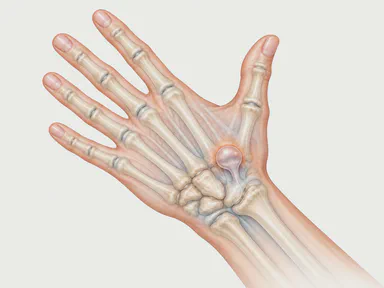
- Ganglion cyst: a sac filled with joint fluid, usually on the back or palm side of the wrist or at the base of a finger. It is the most common lump of the hand. It is covered in detail on the ganglion cyst page.
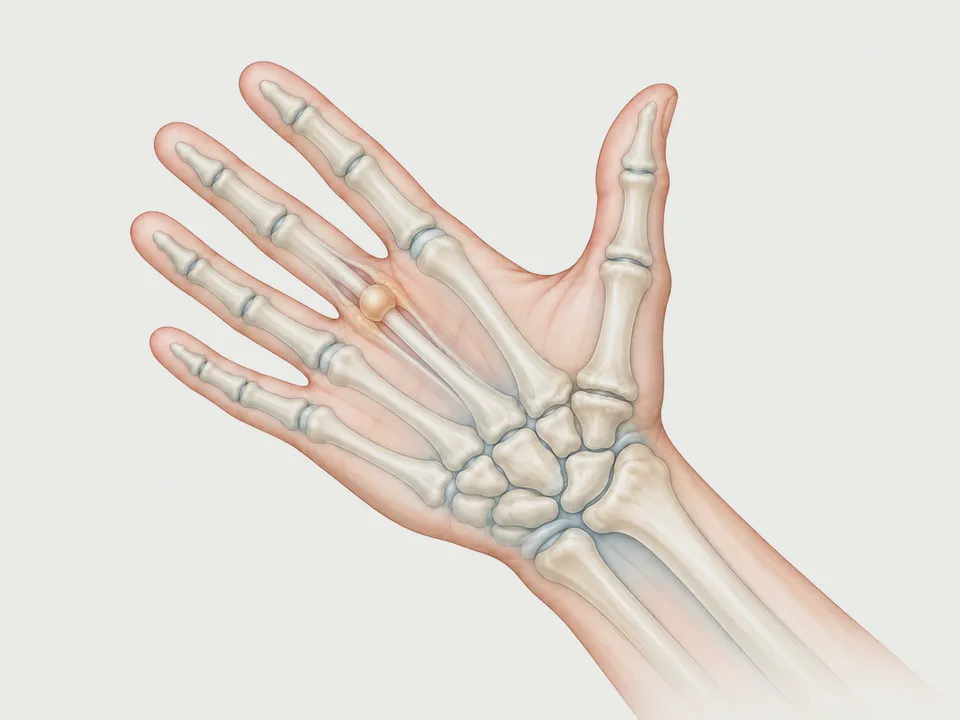
- Giant cell tumour of the tendon sheath: a firm, slow-growing, painless nodule on the palm side of the fingers, next to a flexor tendon. It is the most common solid tumour of the hand. It is benign, but tends to spread around the tendon and can recur if any remnant is left after removal.
- Lipoma: a soft, mobile accumulation of fat, in the palm, forearm or back of the hand. It grows slowly and is only operated on if it causes trouble, grows, or compresses a nerve.
- Glomus tumour: a tiny, often invisible nodule, located under the nail or in the fingertip pad. It produces the classic triad of intense pain at the slightest touch, sensitivity to cold, and pain highly localised to one point. A bluish mark under the nail or deformity of the nail plate can be seen. MRI helps locate it. Complete removal makes the pain disappear.
- Enchondroma: a benign bone tumour formed from cartilage, the most common tumour of the bones of the hand. It is often discovered by chance on an X-ray or when a fracture of the phalanx occurs with a minor knock. It is treated with curettage and, if necessary, filling with a bone graft.
- Epidermoid inclusion cyst: a firm lump in the fingertip pad or palm that appears months after a puncture or cut, caused by skin cells left deep in the tissue that continue producing keratin. It is removed together with its capsule.
Other, less common benign tumours include those of nerve origin, such as schwannoma, and vascular tumours.
Treatment
Not every lump requires surgery. A small, symptom-free ganglion cyst or lipoma can be monitored. In cysts, needle drainage is possible, although recurrence is common. An enchondroma without a fracture and without aggressive features can be followed with periodic X-rays.
When is surgery necessary?
Removal of the tumour is recommended when:
- it causes pain or limits movement;
- it grows or changes in appearance;
- it compresses a nerve or a tendon;
- it has weakened a bone or caused a fracture;
- there is diagnostic doubt and tissue analysis is needed;
- the person wants it removed because of the trouble it causes, after learning the risks and the possibility of recurrence.
Surgery for benign tumours of the hand
The procedure involves the complete removal of the lesion together with its capsule, sparing the neighbouring tendons, nerves and vessels. It is usually carried out on an outpatient basis, with local or regional anaesthesia and with limb ischaemia to see the structures clearly. In small tumours or those close to nerves and vessels, such as a glomus tumour under the nail or a giant cell tumour surrounding a flexor tendon, loupes or a microscope and microsurgery techniques are used. In bone tumours, the lesion is curetted out and the cavity is filled with a graft if the bone has been left weak. Wherever possible, minimally invasive surgery approaches are used, with small incisions oriented along the skin creases.
All removed tissue is sent for pathology analysis to confirm the diagnosis.
Recovery
In most cases the fingers are moved from the first day and the stitches are removed at two weeks. The scar can be tender for a few weeks. After removal of a subungual tumour, the nail can take several months to grow back normally. After curettage of an enchondroma, the finger is protected for a few weeks until the bone consolidates. Subsequent follow-up depends on the type of tumour: those that can recur, such as the ganglion cyst and the giant cell tumour, are reviewed periodically.
Specialist in benign tumours of the hand in Barcelona
Dr Marta Martí Puente is a specialist in Orthopaedic Surgery and Traumatology with a focus on hand surgery and microsurgery. At her consultation in Barcelona she assesses any lump of the hand or wrist individually, with the tests needed to reach a diagnosis, and performs removal when indicated, with confirmation from tissue analysis and subsequent follow-up.
Frequently asked questions
A lump has appeared on my hand — should I be worried?
Do all benign tumours of the hand need to be operated on?
Is whatever is removed analysed?
Can it come back after surgery?
What is a glomus tumour and why does it hurt so much?
Related conditions
Sources and references
The information on this page is general and educational. It does not replace an individual medical assessment.
