

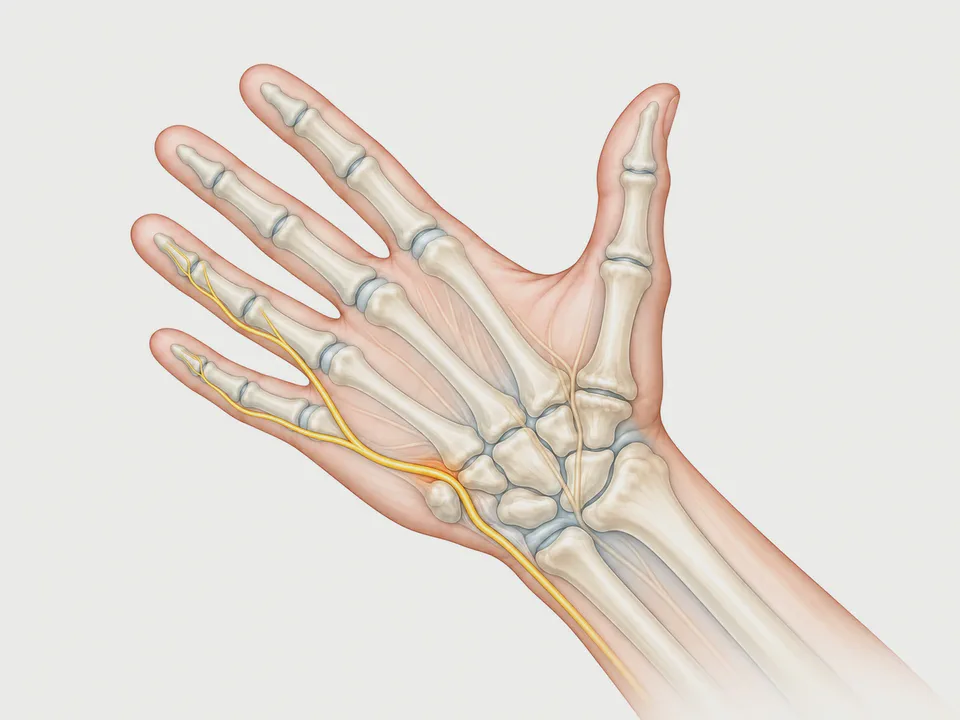
What is ulnar nerve compression in Guyon’s canal?
Guyon’s canal is a small tunnel on the palm side of the wrist, on the little-finger side, bounded by two carpal bones, the pisiform and the hook of hamate, and covered by a ligament. The ulnar nerve and ulnar artery pass through it on their way to the hand. Right at this point the nerve divides into a sensory branch, which collects sensation from the little finger and half of the ring finger, and a deep motor branch, which moves most of the small muscles of the hand.
When the nerve is compressed within the canal, Guyon’s canal syndrome, or ulnar tunnel syndrome of the wrist, appears. It is much less common than carpal tunnel syndrome, with which it shares close quarters, and less common than compression of the same nerve at the elbow. Depending on the exact point of compression, symptoms can be sensory, motor, or both.
Symptoms
Tingling in the ring and little fingers
The most common symptom is tingling or numbness of the little finger and half of the ring finger, on the palm side. Unlike compression at the elbow, sensation on the back of the hand is preserved, because the branch that supplies it separates from the nerve before the wrist.
Weakness and clumsiness of the hand
Involvement of the motor branch causes loss of strength when gripping and when spreading and bringing the fingers together, clumsiness with fine movements, such as doing up buttons or writing, and difficulty holding a sheet of paper between the fingers.
Wasting and deformity
In prolonged compressions, wasting of the muscle between the thumb and index finger and in the little-finger pad can be seen, and the ring and little fingers can adopt a claw-like posture. These signs indicate the nerve has been affected for some time.
Causes and risk factors
Unlike carpal tunnel syndrome, there is usually an identifiable cause in Guyon’s canal syndrome:
- a ganglion cyst arising from the carpal joints and occupying the canal, the most common cause;
- repeated pressure on the palm, as in cyclists who rest their weight on the handlebar, in the use of vibrating tools, or walking sticks;
- a fracture of the hook of hamate, typical of golfers, tennis players and baseball players, or after-effects of other wrist fractures;
- thrombosis or an aneurysm of the ulnar artery, known as hypothenar hammer syndrome, in people who use the palm to strike things;
- accessory muscles, benign soft-tissue tumours, or thickening of the ligament;
- conditions that favour neuropathies, such as diabetes or rheumatoid arthritis.
Diagnosis
Examination identifies the distribution of the tingling, the strength of the small hand muscles, the presence of wasting, and tenderness on percussion over the canal. It is essential to distinguish compression at the wrist from compression at the elbow and from a neck problem, which can produce similar symptoms.
Electromyography confirms involvement of the ulnar nerve and helps locate the level of compression. Ultrasound and MRI look for the cause within the canal, such as a cyst or a vascular abnormality. If there is a history of a fall or of a racquet or stick sport, an X-ray with a specific view or a CT scan is requested to rule out a fracture of the hook of hamate.
Treatment
When the cause is external pressure and symptoms are recent, conservative treatment is usually enough:
- avoiding pressure on the palm and adapting the movement that causes it, with padded gloves, a change in hand position, or adjusting the handlebar;
- a wrist splint in a neutral position, especially at night, for a few weeks;
- anti-inflammatories for short periods, if indicated;
- control of the underlying condition, if present.
A cyst, a fracture, or a vascular injury are not resolved with these measures and require treatment aimed at the cause.
When is surgery necessary?
Surgery is considered when:
- there is a structural cause, such as a cyst, a bone fragment, or an artery injury, compressing the nerve;
- there is loss of strength, wasting, or a claw-like posture, signs that the nerve is being damaged;
- sensory symptoms persist despite conservative treatment for several weeks;
- electromyography shows moderate or severe involvement.
The longer the nerve has been compressed, the less complete the recovery tends to be, so it is best not to delay the decision when motor signs are present.
Guyon’s canal surgery
The procedure involves opening the roof of the canal through a small incision on the palm side of the wrist, releasing the nerve and its two branches along their entire course, and treating the cause: removing the cyst, removing a bone fragment, or resolving the vascular problem. When the nerve is very adherent or a vessel needs repair, microsurgery techniques with magnification are used. It is carried out on an outpatient basis, with regional anaesthesia, and forms part of peripheral nerve surgery. If carpal tunnel syndrome coexists, both can be released during the same procedure.
Recovery
The fingers are mobilised from the first day, and dressings are changed until the stitches are removed, at around two weeks. The tingling usually improves within the first few weeks. The strength of the small hand muscles recovers more slowly, over months, and can benefit from hand therapy. In long-standing compressions with wasting, recovery can be partial, something that is explained before surgery. Return to cycling or to activities involving pressure on the palm is done progressively and with protection.
Specialist in Guyon’s canal syndrome in Barcelona
Dr Marta Martí Puente is a specialist in Orthopaedic Surgery and Traumatology with a focus on hand surgery, the wrist, and peripheral nerves. At her consultation in Barcelona she locates the level of ulnar nerve compression, looks for its cause with the appropriate tests, and proposes conservative treatment or surgical release depending on each case.
Frequently asked questions
How do I know if the ulnar nerve compression is at the wrist or at the elbow?
Is this the same as carpal tunnel syndrome?
Why do my fingers tingle after cycling?
Does surgery restore hand strength?
What tests do I need?
Related conditions
Sources and references
The information on this page is general and educational. It does not replace an individual medical assessment.
