

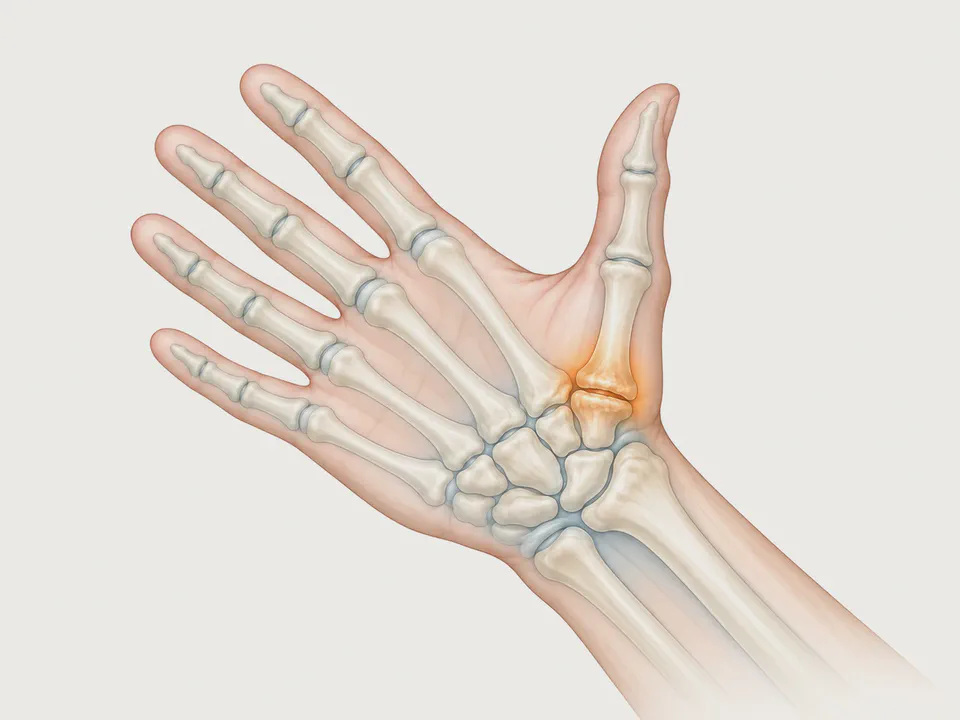
What is thumb base arthritis?
Thumb base arthritis, or rhizarthrosis, is osteoarthritis of the trapeziometacarpal joint, located at the base of the thumb, between the trapezium bone and the first metacarpal. This joint allows the thumb to move away from the palm, rotate, and oppose the other fingers, and it bears high loads every time we pinch or grip something. Over time, the cartilage lining the joint surfaces wears away, the bone deforms, and pain and loss of strength appear.
It is one of the most common sites of hand osteoarthritis and mainly affects women from the age of 50 onwards. Many people live with it for years with only mild discomfort. In others, the pain ends up limiting everyday movements such as turning a key, opening a jar, wringing out a cloth, or writing.
Symptoms
Pain at the base of the thumb
The main symptom is pain at the base of the thumb, near the wrist, which increases with pinching and strong gripping and, at first, settles with rest. In more advanced stages it can also hurt at rest or at night.
Loss of strength and precision
It becomes difficult to hold objects firmly, things slip from the hand, and fine tasks, such as doing up buttons or opening a container, become laborious.
Deformity and stiffness
The base of the thumb can become enlarged and take on a “squared-off” appearance. Over time, the first metacarpal tends to shift outward and the thumb loses its span, something the hand compensates for by hyperextending the next joint. Clicking when moving the joint is not unusual.
Causes and risk factors
Thumb base arthritis is usually the result of several combined factors:
- the progressive wear of the cartilage linked to age;
- hormonal factors and greater ligament laxity, which partly explain why it is more common in women;
- a previous fracture or dislocation at the base of the thumb;
- work or leisure activities involving intense and repeated pinching;
- a family history of osteoarthritis in the hands.
Diagnosis
Examination is very telling: pain localised to the base of the thumb, discomfort on compressing and rotating the joint, and reduced pinch strength. Plain X-rays confirm the diagnosis, show the degree of wear, and allow a check of whether neighbouring joints are also affected, which influences the choice of treatment.
Usually no further tests are needed. Ultrasound can be useful when an associated De Quervain’s tenosynovitis is suspected, since both cause pain on the same side of the wrist and sometimes coexist.
Treatment
Treatment almost always starts with conservative measures, which in many cases control the symptoms for a long time:
- adapting the movements that cause the most pain, and using thick-handled utensils or technical aids;
- a brace or splint that stabilises the base of the thumb, during activity or at night depending on the case;
- analgesics or anti-inflammatories for short periods, if indicated;
- strengthening exercises for the thumb muscles and hand therapy, which help stabilise the joint;
- corticosteroid injection into the joint during episodes of intense pain, with an effect of variable duration.
The X-ray and the pain do not always go hand in hand. Some people have advanced wear with little discomfort, and others have modest changes with a great deal of pain. For this reason, treatment is decided on the basis of symptoms and limitation, not on imaging alone.
When is surgery necessary?
Surgery is considered when:
- pain persists after several months of properly carried out conservative treatment;
- it limits work, night-time rest, or everyday activities;
- loss of strength or deformity prevent normal use of the thumb.
A very abnormal X-ray on its own is not a reason to operate if the hand functions and the pain is tolerable.
Thumb base arthritis surgery
Several techniques exist, and the choice depends on the degree of osteoarthritis, age, the demands placed on the hand, and each person’s preferences:
- Trapeziectomy: the trapezium bone, the source of the painful friction, is removed. It can be completed with a ligament reconstruction or tendon interposition to provide stability at the base of the thumb. It is the technique with the longest track record and offers lasting pain relief.
- Trapeziometacarpal arthroplasty or prosthesis: replaces the joint with an implant. It tends to better preserve the length and strength of the thumb and usually allows a faster recovery, although, like any prosthesis, it carries a risk of loosening or dislocation in the long term.
- Arthrodesis: fixes the joint. It is reserved for specific cases, for example younger people with heavy manual work.
All of these are usually performed on an outpatient basis, with regional anaesthesia of the arm, and with small incisions as part of a minimally invasive surgery approach. They form part of standard hand surgery practice.
Recovery
After the operation a splint is worn for a few weeks, the length of time depending on the technique used. Mobility exercises then begin and, later, strengthening exercises, often guided by a hand therapist. The pain present before the operation usually improves within the first few weeks. Pinch strength recovers progressively and can keep improving for several months. It is advisable to avoid intense loading of the thumb until the doctor indicates otherwise.
Specialist in thumb base arthritis in Barcelona
Dr Marta Martí Puente is a specialist in Orthopaedic Surgery and Traumatology with a focus on hand and wrist surgery. At her consultation in Barcelona she assesses each case of thumb base arthritis individually, from splints and exercises through to trapeziectomy or prosthesis when indicated, and supports recovery through to regaining a useful, pain-free pinch.
Frequently asked questions
Can thumb base arthritis be cured?
Is it any use wearing a splint?
Is trapeziectomy or a prosthesis better?
How long does recovery take after thumb base arthritis surgery?
Could it be tendinitis rather than osteoarthritis?
Related conditions
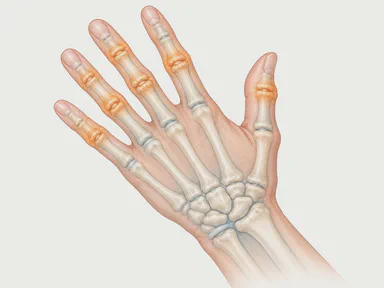
- Finger osteoarthritis Pain, stiffness and nodes in the finger joints caused by cartilage wear, especially in the joints closest to the nail.
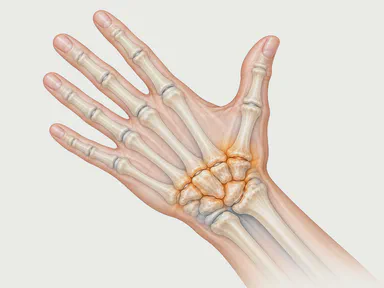
- Wrist osteoarthritis Wear of the wrist cartilage, almost always a consequence of an old fracture or ligament rupture, causing progressive pain and stiffness.
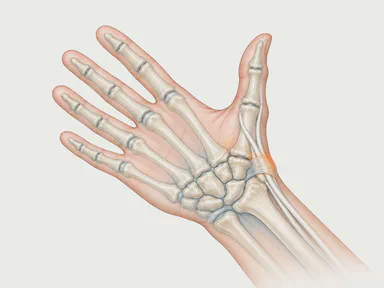
- De Quervain's Pain on the thumb side of the wrist when pinching, rotating or lifting weight, caused by irritation of the sheath around the thumb tendons.
Sources and references
The information on this page is general and educational. It does not replace an individual medical assessment.
