

What is a ganglion cyst?
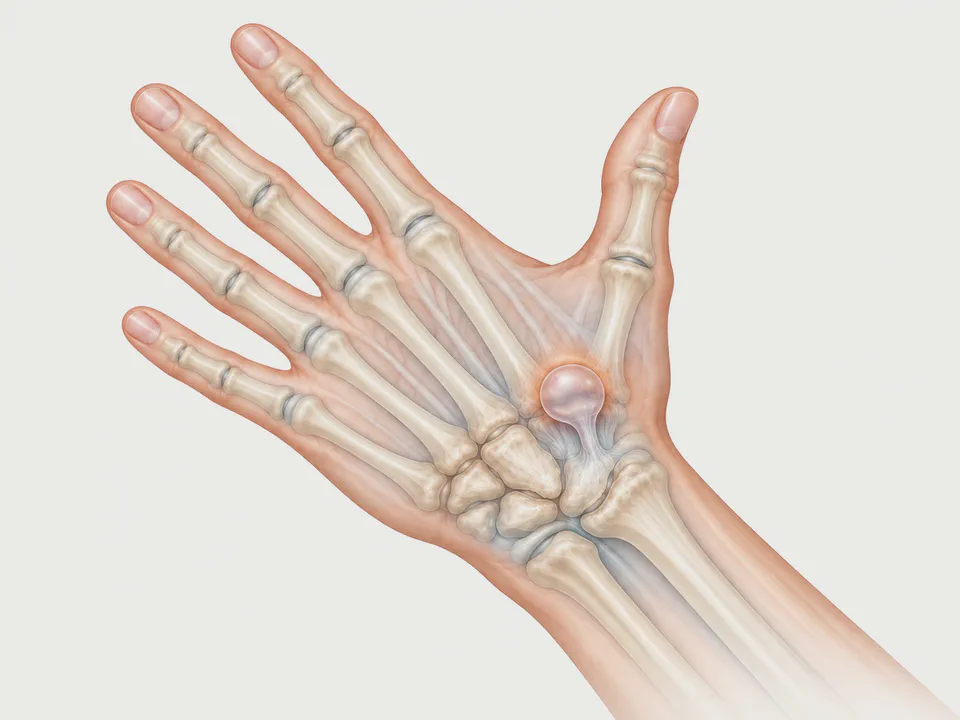
A ganglion cyst, also known as a synovial cyst, is a benign lump filled with a thick, clear fluid, similar to the fluid that lubricates the joints. It arises from the capsule of a joint or the sheath of a tendon, with which it communicates through a small stalk that acts like a valve: fluid enters the cyst but struggles to leave.
It is the most common soft-tissue lump of the hand and wrist. The most frequent locations are:
- the back of the wrist, arising from the joint between the scaphoid and the lunate, which is the most common location;
- the palm side of the wrist, next to the pulse, close to the radial artery;
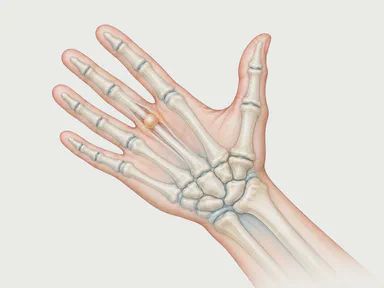
- the base of the fingers, in the palm, over the flexor tendon sheath, the so-called pulley cyst, described on the trigger finger page;
- the back of the last finger joint, the mucous cyst, associated with osteoarthritis of the fingers.
It is more common in young and middle-aged women, although it can appear at any age.
Symptoms
A lump that changes size
The usual finding is a rounded, smooth, somewhat soft mass, which can grow with activity and shrink with rest, or even disappear and come back. Its size ranges from a pea to several centimetres.
Pain or discomfort with activity
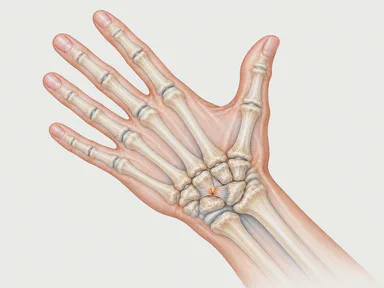
Many cysts do not hurt. Others cause a dull ache in the wrist when bearing weight, doing press-ups, or extending the wrist fully, along with a certain feeling of weakness when gripping. A small, non-visible cyst on the back of the wrist, the so-called occult ganglion, can be a cause of dorsal wrist pain with no visible lump.
Other symptoms
A palmar cyst close to the radial artery can pulsate with the pulse. A ganglion in Guyon’s canal can compress the ulnar nerve and cause tingling in the ring and little fingers. Mucous cysts of the fingers can deform the nail or open onto the skin.
Causes and risk factors
It is not known for certain why these appear. It is thought that irritation of the joint capsule or tendon sheath triggers the formation of the cyst. They are more common in people who subject the wrist to repeated loading, such as gymnasts, and can be associated with a wrist ligament injury or with osteoarthritis at the dorsal and digital locations. In most cases, however, there is no clear preceding cause.
Diagnosis
Diagnosis is usually made on examination: the location, consistency, and the fact that the lump transilluminates when a light is held against it are very characteristic. Ultrasound confirms that it is a cystic lesion, shows its relationship to the joint or tendon, and rules out other masses of the hand. An X-ray is requested when osteoarthritis or an associated bone lesion is suspected, and MRI is reserved for the occult ganglion or for cases with diagnostic doubt.
Treatment
Treatment depends on the symptoms, not the size:
- Observation: if the cyst does not hurt or limit function, it is reasonable to wait, because a proportion of them disappear spontaneously. There is no need to treat a cyst just because it is visible.
- Aspiration: draining the cyst with a needle relieves the tension and can be combined with an injection. It is simple, but recurrence is common because the wall of the cyst remains in place. It is not recommended in palmar cysts next to the radial artery.
- Splint and activity adaptation: during painful periods, reducing the load on the wrist can decrease the size and the discomfort.
Hitting the cyst to burst it, a traditional remedy, is not advised because it can injure the surrounding tissues and the cyst usually reforms.
When is surgery necessary?
Removing the cyst is considered when:
- it hurts or limits activity persistently;
- it has recurred after aspiration;
- it compresses a nerve or a tendon;
- its size or location causes continuous trouble and the person prefers to resolve it.
Ganglion cyst surgery
The procedure involves removing the cyst together with its stalk and a small portion of the joint capsule from which it arises. It is this last step that reduces the risk of recurrence. It can be done openly, through a small incision, or by wrist arthroscopy for dorsal cysts, which allows the base of the cyst to be resected from inside the joint with minimal incisions while also checking the state of the ligaments. In palmar cysts, the radial artery needs to be identified and protected. It is carried out on an outpatient basis, with regional or local anaesthesia, as part of minimally invasive surgery of the wrist.
Recovery
After surgery, a dressing is worn for a few days and, sometimes, a short splint for extra comfort. The fingers move from the first day and the wrist progressively. Stitches are removed at around two weeks. There can be some stiffness or discomfort when forcing wrist extension for a few weeks, which resolves with exercises. Loaded activities are resumed gradually over the following weeks.
Specialist in ganglion cyst in Barcelona
Dr Marta Martí Puente is a specialist in Orthopaedic Surgery and Traumatology with a focus on wrist surgery and the hand. At her consultation in Barcelona she confirms the diagnosis of the cyst, rules out other lesions, and explains whether it is best to observe, aspirate, or operate, with an open or arthroscopic technique depending on the location.
Frequently asked questions
Can a ganglion cyst be cancer?
Can it disappear on its own?
Is it any use puncturing and draining it?
Can it come back after surgery?
Is it true that hitting it with a book can burst it?
Related conditions
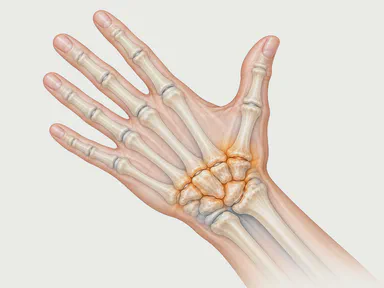
- Wrist ligaments Sprains and ruptures of the ligaments joining the carpal bones, especially the scapholunate ligament, which can destabilise the wrist and lead to osteoarthritis.
- Wrist osteoarthritis Wear of the wrist cartilage, almost always a consequence of an old fracture or ligament rupture, causing progressive pain and stiffness.
- Hand tumours Most lumps in the hand and wrist are benign, but every lump deserves a diagnosis: cysts, soft-tissue tumours and bone tumours.
Sources and references
The information on this page is general and educational. It does not replace an individual medical assessment.
