

What are nerve injuries of the hand and wrist?
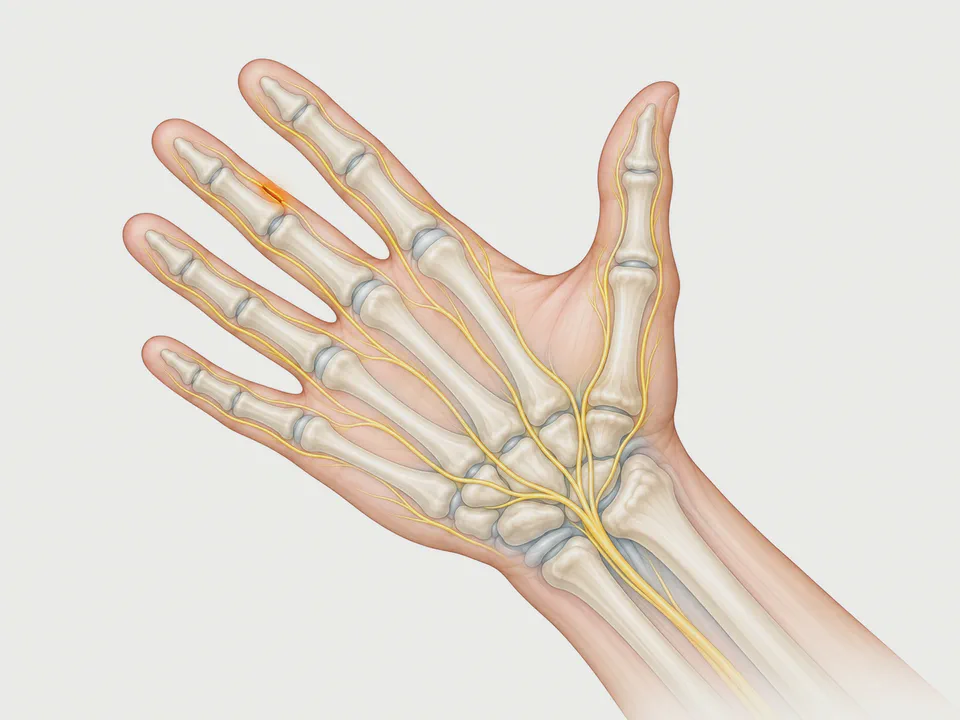
Three main nerves reach the hand: the median, the ulnar and the radial. They branch into finer nerves, the digital nerves, which run along the sides of each finger just beneath the skin. They carry sensation from the skin to the brain and movement commands to the small muscles of the hand. When one of them is cut, crushed, stretched, or compressed for a sustained period, it stops transmitting signals properly, and numbness, weakness or pain appear.
A nerve injury can be a clean section from a wound, a partial injury from crushing or traction, a neuroma at the end of a cut nerve, or a chronic compression such as carpal tunnel syndrome. Treatment lies within the field of peripheral nerve surgery and frequently requires microsurgical techniques.
Symptoms
- Loss of sensation in a specific area of the hand or a finger, corresponding to the territory of the nerve affected: the median nerve covers the thumb, index, middle finger and half of the ring finger; the ulnar nerve, the little finger and the other half of the ring finger; the digital nerves, one side of each finger.
- Tingling or an electric-shock sensation.
- Weakness or clumsiness when spreading the fingers, pinching, or holding small objects.
- Pain in the scar or at a very localised point, which flares up when touched: this is typical of a neuroma.
- Dry skin or temperature changes in the numb area.
- In old injuries, wasting of the muscles at the base of the thumb or between the fingers.
Causes and risk factors
- Cut wounds from glass, knives or tools, especially at the wrist, palm and fingers, where the nerves are very superficial. Tendons and vessels are frequently cut at the same time.
- Fractures and dislocations that stretch or bruise the nerve.
- Crush injuries and workplace or traffic accidents.
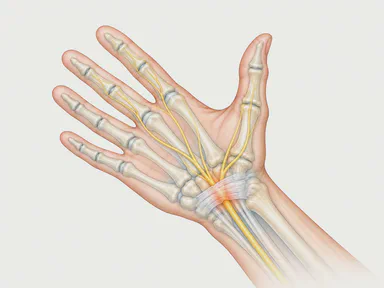
- Compressions from splints, sustained postures, cysts, or the anatomical tunnel itself, as in carpal tunnel syndrome or Guyon’s canal.
- Injuries during other procedures or injections, uncommon but possible.
Diagnosis
Clinical examination in the acute phase is decisive: the sensation in each area of the hand and the strength of each muscle group are checked and compared with the healthy side. Numbness in half of a finger after a wound is considered a digital nerve section until proven otherwise, and justifies exploring the wound in theatre.
In closed injuries, or those with a longer course, electromyography is used, which measures nerve conduction and muscle activity, along with ultrasound or MRI, which locate the level of the injury, a neuroma, or a cause of compression. As regeneration is slow, tests sometimes need to be repeated after a few weeks to see whether the nerve is recovering on its own.
Treatment
Not every nerve injury is operated on. Contusions and stretches in which the nerve retains its continuity usually recover on their own, and are treated with protection, pain control and clinical follow-up. Mild compressions respond to splints, activity changes and injections.
While the nerve is recovering, rehabilitation keeps the joints mobile, protects the numb skin from burns and wounds, and later retrains sensation so the brain learns to interpret the signals again.
When is surgery necessary?
Surgery is indicated when:
- there is a section of the nerve, either open or shown on tests;
- a closed injury shows no signs of recovery within the expected timeframe;
- there is a painful neuroma that limits use of the hand;
- a compression causes loss of sensation or strength and does not respond to conservative treatment.
In clean sections, repair within the first few days offers the best conditions, because the ends have not yet retracted or scarred.
Surgery for nerve injuries
Repair is carried out using microsurgery, under a microscope, with sutures finer than a hair, to align the fascicles of the two ends with maximum precision. Depending on the situation:
- When the ends can be brought together without tension, a direct suture of the nerve is performed.
- When there is a gap between the ends, due to tissue loss or an old injury, a nerve graft is interposed, usually taken from the leg or the forearm, or, in short gaps, a guide conduit that directs growth.
- In a neuroma, the thickened end is removed and the nerve end is repositioned into a muscle or a neighbouring nerve so it stops being painful.
- In compressions, the tunnel trapping the nerve is released.
These techniques form part of hand microsurgery and are performed under regional or general anaesthesia, depending on the extent of the injury.
Recovery
Recovery of a repaired nerve is slow. The fibres grow back from the suture point towards the skin or muscle at a rate of roughly one millimetre a day, which means an injury at the wrist can take many months to reach the fingertips. Sensation usually recovers before the fine strength of the hand muscles, and both continue to improve for one or two years.
The outcome depends on age, the nerve involved, the level of the injury, and the time elapsed before repair. In young people and in distal injuries, such as those of the digital nerves, recovery is usually good; in high or old injuries it can be partial, something that is explained before surgery. Throughout the process, sensory re-education and protection of the skin form part of the treatment.
Specialist in nerve injuries in Barcelona
Dr Marta Martí Puente is a specialist in Orthopaedic Surgery and Traumatology with a focus on hand and wrist surgery and microsurgery of the peripheral nerves. At her consultation in Barcelona she assesses each nerve injury individually, from following up a contusion through to microsurgical suture or grafting, and supports the long recovery of the nerve through to the best possible function.
Frequently asked questions
I've cut myself and half of my finger is numb — is that serious?
Does a cut nerve work again?
How long does it take for sensation to recover?
What is a neuroma?
Related conditions
- Carpal tunnel Night-time tingling, numbness in the fingers and loss of strength caused by compression of the median nerve at the wrist.
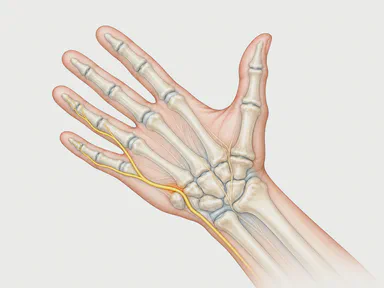
- Guyon's canal Tingling in the ring and little fingers and loss of hand strength caused by compression of the ulnar nerve at the wrist.
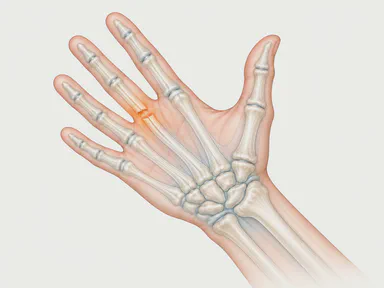
- Tendon injuries Cuts, ruptures and detachments of the tendons that move the fingers: from mallet finger to deep wounds requiring urgent repair.
Sources and references
The information on this page is general and educational. It does not replace an individual medical assessment.
