

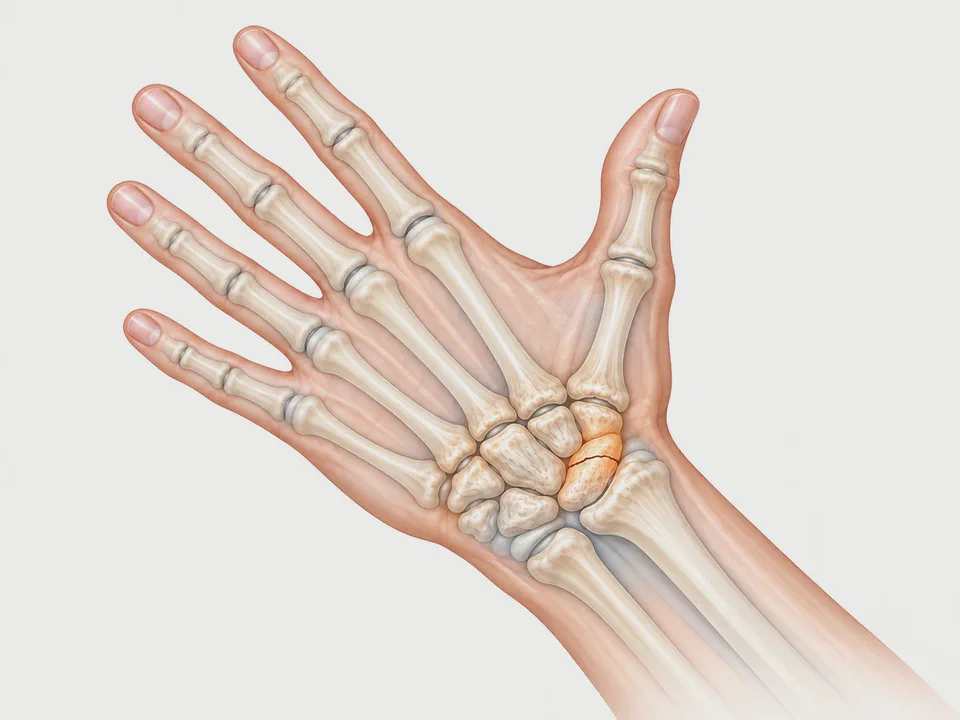
What is a scaphoid fracture?
The scaphoid is a small, bean-shaped bone in the first row of the carpus, just below the base of the thumb. It acts as a bridge between the two rows of wrist bones, and much of the stability of the carpus depends on it. The scaphoid fracture is the most common fracture of the wrist bones, not counting the radius.
It has two particularities that make it special. The first is that it often does not show up on the initial X-ray, so many people mistake it for a sprain and carry on using the hand. The second is that its blood supply is sparse and enters through the distal end, so the proximal fragment can be left without a blood supply. Both of these explain why an apparently minor fracture can end up as a nonunion (failure to heal) or avascular necrosis (death of the bone due to lack of blood supply).
Symptoms
- Pain at the base of the thumb, in the area known as the anatomical snuffbox, which increases with pinching or putting weight through the hand.
- Mild swelling on the radial border of the wrist.
- Pain on moving the wrist, especially towards the thumb side and when rotating the forearm.
- Loss of grip strength.
Unlike a distal radius fracture, deformity is rare. The pain can be moderate and improve over the following days, which delays the consultation.
Causes and risk factors
The usual mechanism is a fall onto an outstretched hand with the wrist in hyperextension. It is typical of active young people, in sports such as football, basketball, skating or cycling, and also in motorcycle accidents. It sometimes occurs in the context of more significant trauma, together with injuries to the wrist ligaments or a radius fracture.
The main factor affecting prognosis is not the fall itself, but delayed diagnosis: the longer a fracture goes without immobilisation, the higher the risk that it will fail to heal.
Diagnosis
Faced with pain in the anatomical snuffbox after a fall, X-rays are taken with specific scaphoid views. If these are normal but clinical suspicion is high, the correct approach is to immobilise the wrist and repeat the X-ray after ten to fourteen days, when the fracture line becomes more visible, or to request an MRI directly, which detects the fracture from the first day.
CT is the test of choice for assessing displacement, the angulation of the fragments, and, later on, the degree of healing. Locating the fracture in the distal third, the waist, or the proximal pole is important, because the prognosis and treatment change from one area to another.
Treatment
Non-displaced fractures of the distal third and the waist are usually treated with immobilisation, with a cast or splint that includes the base of the thumb. Healing time is longer than for other fractures: often between six and twelve weeks, with imaging checks to confirm union before the immobilisation is finally removed.
During that period it is advisable to keep the fingers, elbow and shoulder moving and to avoid loading the wrist. Smoking reduces blood supply and hinders healing, so it is advisable to avoid it.
When is surgery necessary?
Surgery is considered in the following situations:
- a displaced or angulated fracture;
- a fracture of the proximal pole, due to its higher risk of necrosis and nonunion;
- a fracture associated with other wrist injuries;
- nonunion or delayed healing with conservative treatment;
- a stable fracture in people who need to shorten the immobilisation period for work or sporting reasons, after weighing up risks and benefits.
Scaphoid fracture surgery
The usual technique is fixation with a headless compression screw that sits inside the bone and compresses the fragments together. In non-displaced fractures it can be placed percutaneously, through an incision of only a few millimetres and under X-ray guidance, without opening the joint. Wrist arthroscopy helps to check the reduction and detect associated ligament injuries.
When nonunion is present, surgery is more complex: the fracture site is cleaned, filled with a bone graft, taken from the radius or the iliac crest, and fixed with a screw. If the proximal fragment has lost its blood supply, a vascularised graft may be needed. These procedures are part of surgery for hand and wrist fractures.
Recovery
After percutaneous fixation of a non-displaced fracture, immobilisation is usually brief and mobility starts within the first few weeks, although loading and contact sport are delayed until imaging confirms healing. After nonunion surgery with a graft, immobilisation and follow-up take longer.
An untreated nonunion alters the mechanics of the carpus and, over the years, can produce a progressive pattern of wrist osteoarthritis, known as the SNAC wrist. Diagnosing and treating the fracture in time is the best way to prevent this.
Specialist in scaphoid fracture in Barcelona
Dr Marta Martí Puente is a specialist in Orthopaedic Surgery and Traumatology with a focus on wrist surgery and the hand. At her consultation in Barcelona she assesses each scaphoid fracture individually, from immobilisation through to percutaneous fixation or treatment of nonunion, and supports recovery through to a return to sport or work.
Frequently asked questions
The X-ray was normal — can I still have a scaphoid fracture?
Why does the scaphoid take so long to heal?
What is scaphoid nonunion?
Does screw surgery shorten recovery?
Related conditions
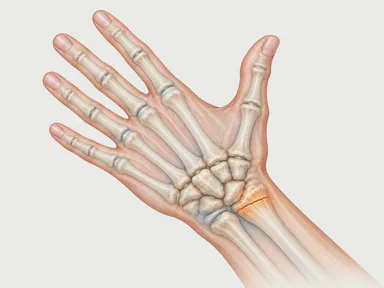
- Distal radius fracture The most common wrist fracture: it occurs on falling onto an outstretched hand and can be treated with a cast or with surgery depending on the displacement.
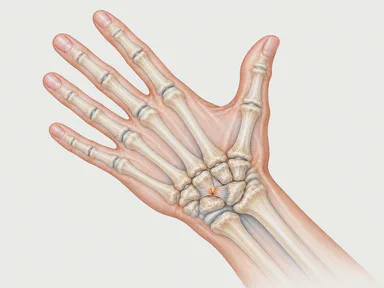
- Wrist ligaments Sprains and ruptures of the ligaments joining the carpal bones, especially the scapholunate ligament, which can destabilise the wrist and lead to osteoarthritis.
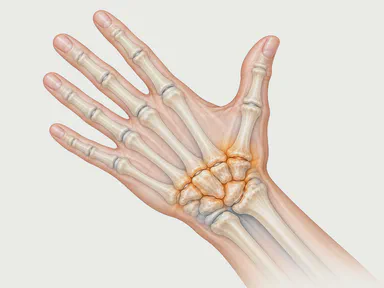
- Wrist osteoarthritis Wear of the wrist cartilage, almost always a consequence of an old fracture or ligament rupture, causing progressive pain and stiffness.
Sources and references
The information on this page is general and educational. It does not replace an individual medical assessment.
