

What is a thumb sprain?
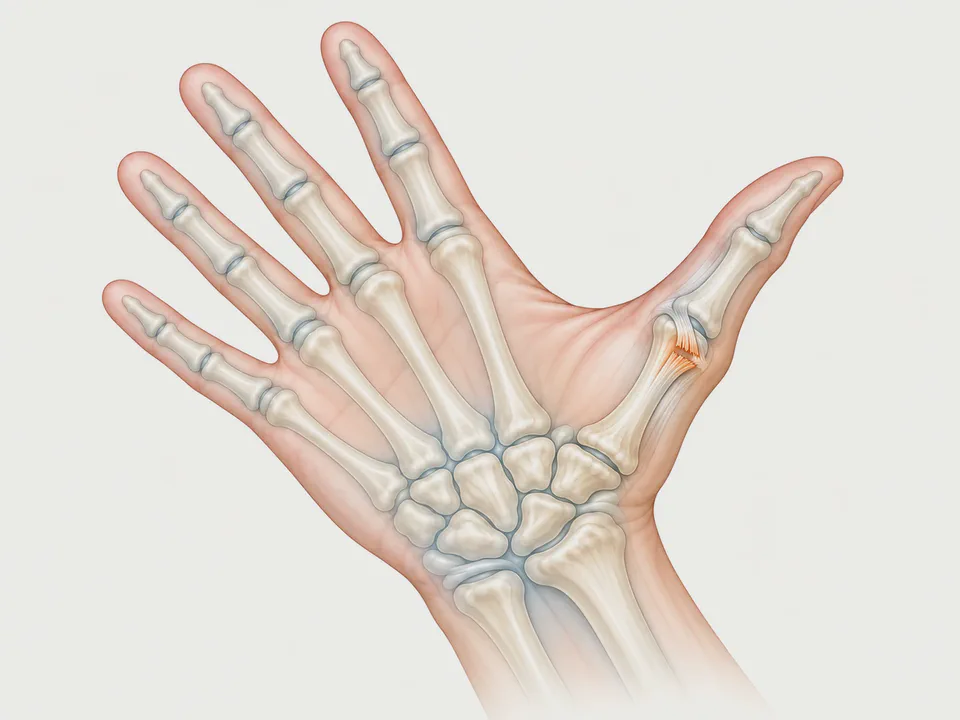
A thumb sprain is an injury to the ligaments that stabilise the metacarpophalangeal joint, which joins the base of the thumb to the first metacarpal. The ligament injured most often is the ulnar collateral ligament, located on the inner side of the thumb, facing the index finger. This is the ligament that withstands pinch: every time we hold something between the thumb and fingers, it prevents the thumb from opening outward.
The injury is caused by a sudden outward deviation of the thumb. The classic mechanism is a fall while skiing with the pole in hand, which is why it is known as skier’s thumb, although it also occurs in falls onto the hand, in football, handball or rugby, and in motorcycle accidents. The chronic form, caused by repeated microtrauma, is known as gamekeeper’s thumb.
It can involve a stretch, a partial tear, or a complete rupture of the ligament, sometimes tearing off a small fragment of bone from the base of the phalanx. Less often, the radial collateral ligament, on the outer side, is injured.
Symptoms
Pain and swelling at the base of the thumb
After the fall, pain, swelling and often a bruise appear on the inner side of the base of the thumb. It hurts to move the joint and to press on the ligament.
Weakness and instability of pinch
It becomes difficult to hold objects between the thumb and index finger, turn a key, or open a door. In complete ruptures, the joint feels loose or unstable when pinching.
A lump on the side of the thumb
In some complete ruptures, a small lump can be felt on the inner side of the joint, corresponding to the displaced end of the ligament, known as a Stener lesion.
Causes and risk factors
The cause is trauma with a forced outward deviation of the thumb. Winter sports, contact and ball sports, bicycle or motorcycle falls, and casual falls onto an outstretched hand are the most common situations. Chronic injuries are seen in jobs or occupations involving repeated pinching effort.
Diagnosis
Examination is key. The stability of the ligament is checked by gently forcing the thumb outward, with the joint straight and bent, and comparing with the other thumb. A clearly greater opening, or one without a firm end point, indicates a complete rupture. When pain prevents examination, this can be done under local anaesthetic.
An X-ray is requested to rule out an avulsion fracture at the base of the phalanx and to assess the joint. If a complete rupture is suspected, ultrasound or MRI can confirm it and detect a Stener lesion, which is decisive in deciding treatment. After a fall onto the hand, it is also worth examining the wrist, as a scaphoid fracture can go unnoticed.
Treatment
Mild sprains and partial tears, in which the ligament maintains a firm end point, are treated conservatively:
- immobilisation of the thumb with a splint or cast that leaves the wrist and the other fingers free, for around four to six weeks;
- local cold and elevation of the hand in the first few days;
- analgesics or anti-inflammatories for short periods, if indicated;
- exercises for mobility and, later, pinch strength, after removing the splint, avoiding contact sports or movements that force the thumb outward for a few more weeks.
It is important not to underestimate an injury of this kind: a “sprain” that is not examined properly can be a complete rupture that, without correct treatment, leaves the thumb unstable.
When is surgery necessary?
Surgery is considered when:
- the ligament rupture is complete, with clear instability on examination;
- there is a Stener lesion, in which the ligament cannot heal on its own;
- there is an avulsion fracture with a displaced fragment or one affecting a significant part of the joint;
- instability persists after correct conservative treatment, or the injury is old and the thumb remains unstable and painful.
Surgery for the ulnar collateral ligament of the thumb
In recent injuries, the procedure involves reinserting the ligament into the bone, usually with a small anchor, or fixing the torn-off bone fragment. It is carried out through a short incision on the inner side of the thumb, under regional anaesthesia and as day surgery, following a minimally invasive surgery approach. When there is an associated fracture, the technique is incorporated into surgery for hand fractures.
In chronic injuries, the retracted ligament can no longer be repaired and is reconstructed with a tendon graft. If the joint has developed osteoarthritis, an arthrodesis may be preferable. All of these techniques are part of standard hand surgery practice.
Recovery
After repair, a thumb splint is worn for around four to six weeks, with the fingers and wrist free. Mobility exercises are then started, followed progressively by strengthening, often guided by a hand therapist. Pinch strength recovers over two or three months, and the return to contact sport is decided at the consultation according to progress. In reconstructions with a graft, timescales are somewhat longer. It is normal for the joint to remain slightly stiffer than the other side, which rarely limits function.
Specialist in thumb sprain in Barcelona
Dr Marta Martí Puente is a specialist in Orthopaedic Surgery and Traumatology with a focus on hand and wrist surgery. At her consultation in Barcelona she examines the stability of the thumb, requests the tests needed to rule out a Stener lesion or a fracture, and proposes splinting or ligament repair according to the severity of the injury.
Frequently asked questions
How do I know if it is a mild sprain or a ligament rupture?
What is a Stener lesion?
How long does the splint need to be worn?
Is surgery urgent?
What happens if it is not treated?
Related conditions
- Wrist ligaments Sprains and ruptures of the ligaments joining the carpal bones, especially the scapholunate ligament, which can destabilise the wrist and lead to osteoarthritis.
- Scaphoid fracture A fracture of the most vulnerable bone in the wrist: often not seen on the first X-ray, and if it fails to heal, it can lead to nonunion.
- Thumb base arthritis Pain and loss of strength at the base of the thumb caused by wear of the trapeziometacarpal joint.
Sources and references
The information on this page is general and educational. It does not replace an individual medical assessment.
