

What is Dupuytren’s disease?
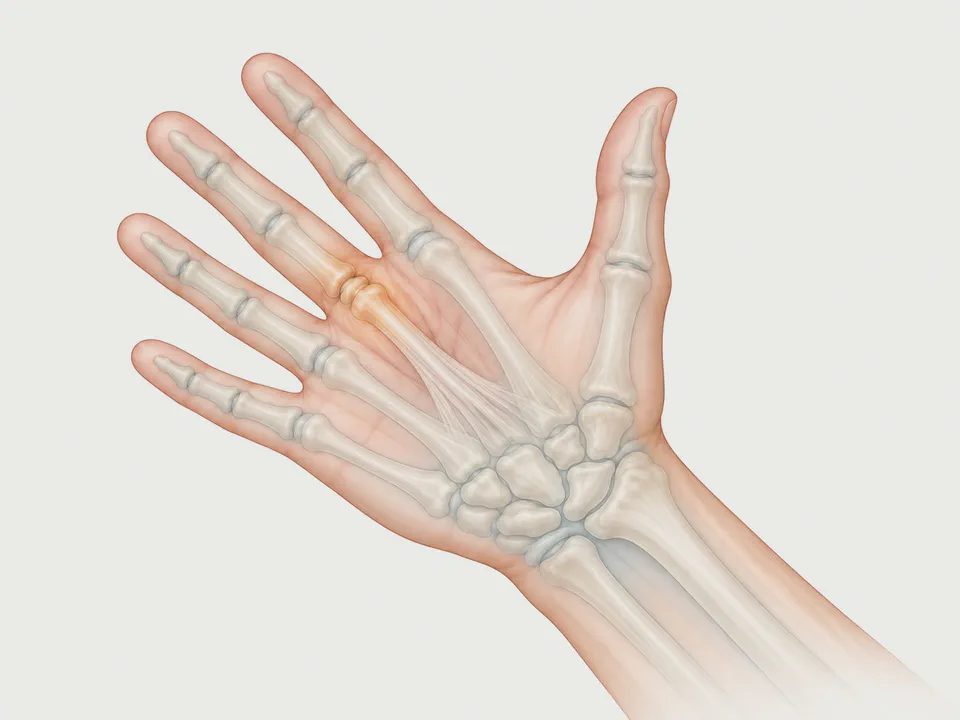
Dupuytren’s disease is a disorder of the palmar fascia, the fibrous tissue beneath the skin of the palm that gives the hand firmness. This tissue thickens, forms nodules and, over time, cords that extend towards the fingers and pull them into flexion. The result is Dupuytren’s contracture: one or more fingers that can no longer be fully straightened.
In many people the progression is slow, and for years only a hardening in the palm is noticeable. In others it progresses faster. Although at first it may seem minor, it can end up making everyday movements difficult, such as putting a hand in a pocket, putting on a glove, washing one’s face, or resting the hand flat on a table. It is more common in men over the age of 50 and in people of Northern European origin.
Symptoms
Nodules or lumps in the palm
The first sign is usually a palpable thickening in the palm, often in line with the ring or little finger. It can sometimes cause local tenderness when resting the hand on a surface, although it is often painless. The skin over the nodule can pucker or dimple.
Cords and finger retraction
Over time, cords appear beneath the skin, which can be felt when straightening the finger, along with a progressive inability to extend it. It most commonly affects the ring and little fingers, although it can appear in any finger, including the thumb, and in both hands.
Functional limitation
More than pain, the main problem is loss of extension. It interferes with work, sport and self-care, and when the finger is very bent it can catch in pockets or make it difficult to wash the hand.
Causes and risk factors
No single cause is known. There is a clear genetic predisposition, with a frequent family history, and the disease becomes more common from a certain age onwards. It is also seen more often in people with diabetes, tobacco or alcohol use, epilepsy treated with certain drugs, and in those with similar thickenings on the sole of the foot or the knuckles. Despite popular belief, it has not been shown to be caused by trauma or manual work.
Diagnosis
Diagnosis is clinical, based on the history and examination of the hand. In the consultation, the nodules and cords are located, the degree of contracture of each joint is measured with a goniometer, and the quality of the skin is assessed.
A simple test is to check whether the hand can be placed flat on a table. When this is no longer possible, the contracture is usually enough to warrant considering treatment. Imaging is not usually needed, unless there is doubt with other diagnoses, such as trigger finger or a joint problem.
Treatment
In early stages, when there are only nodules or a cord without significant contracture, the recommended approach is periodic follow-up. There are no drugs, splints or exercises that have been shown to slow progression, so treating a nodule that does not limit the hand offers no benefit and only unnecessary risks.
When the cord is already bending the finger, the options are:
- Percutaneous needle aponeurotomy: under local anaesthetic, the cord is divided through the skin with the tip of a needle. This is a quick procedure with a very short recovery, indicated for well-defined cords. The contracture tends to recur sooner than after open surgery.
- Fasciectomy: the surgery that removes the diseased tissue, described below.
In some countries, collagenase injection has also been used to weaken the cord; its availability varies and is worth discussing at the consultation.
When is surgery necessary?
Treatment is considered when the contracture already limits function — as a general guide, when the base joint of the finger cannot extend to around 30 degrees, or when any degree of contracture affects the middle joint of the finger, which becomes stiff more easily. It is also considered when the hand can no longer rest flat, when progression is rapid, or when the contracture interferes with work or daily activities. Waiting until the finger is very bent makes full correction harder.
Dupuytren’s surgery
The most common Dupuytren’s surgery is fasciectomy: through zigzag incisions in the palm and finger, the diseased tissue is removed while sparing the nerves, vessels and flexor tendons that run alongside the cord. In severe contractures or recurrences, part of the skin may need to be replaced with a graft. It is usually carried out under regional anaesthesia of the arm, as day surgery, within a minimally invasive surgery approach aiming for small incisions and a fast recovery. It is one of the most common procedures in hand surgery.
Recovery
After fasciectomy, a dressing is worn and, often, a night splint that keeps the fingers extended for several weeks. Dressings are changed every few days until the stitches are removed, at around two weeks. Finger mobilisation starts early, and hand therapy helps regain flexion without losing the extension gained. Most people return to their usual activities between four and eight weeks, although the scar can continue to mature for months. After needle aponeurotomy, recovery takes a few days.
Dupuytren’s disease can recur over the years, so follow-up allows new progression to be detected and the best time to act to be decided.
Specialist in Dupuytren’s disease in Barcelona
Dr Marta Martí Puente is a specialist in Orthopaedic Surgery and Traumatology with a focus on hand and wrist surgery. At her consultation in Barcelona she measures the contracture, explains whether it is best to observe or treat, and performs needle aponeurotomy or fasciectomy depending on the case, supporting recovery through to regaining the ability to open the hand.
Frequently asked questions
Is Dupuytren's disease dangerous?
Can it be treated without surgery?
Do stretching or exercises slow the disease down?
Can it come back after surgery?
When should I book an appointment?
Related conditions
- Trigger finger Clicking, catching or locking of the finger when bending and straightening it, sometimes with a small painful lump in the palm.
- Finger osteoarthritis Pain, stiffness and nodes in the finger joints caused by cartilage wear, especially in the joints closest to the nail.
- Tendon injuries Cuts, ruptures and detachments of the tendons that move the fingers: from mallet finger to deep wounds requiring urgent repair.
Sources and references
The information on this page is general and educational. It does not replace an individual medical assessment.
