

What is osteoarthritis of the fingers?
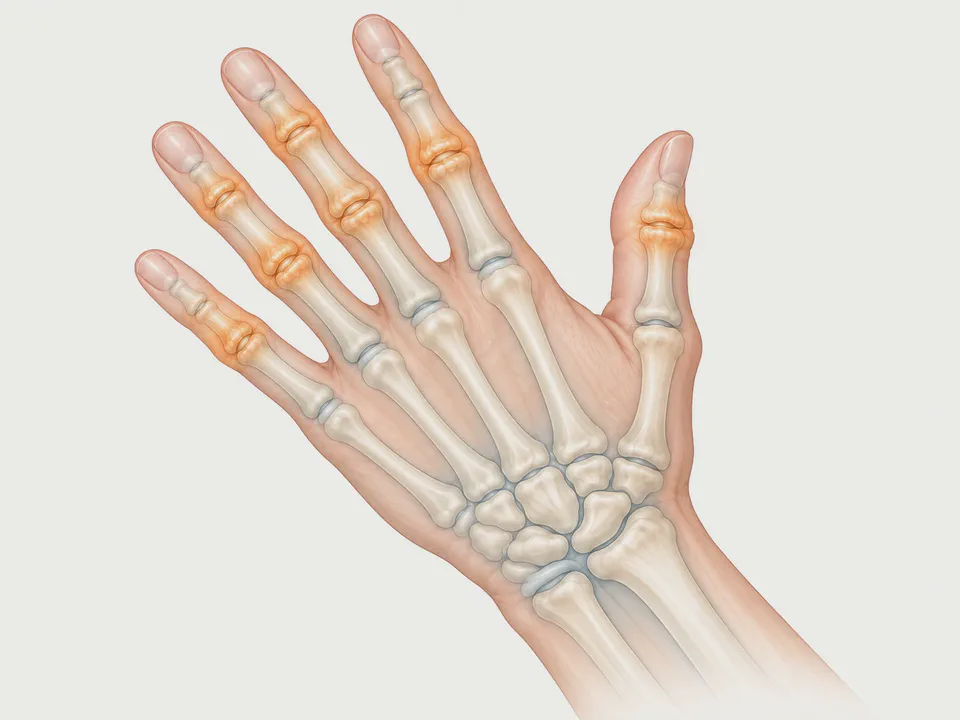
Osteoarthritis of the fingers is the progressive wearing of the cartilage that lines the small finger joints. It mainly affects the distal interphalangeal joints, closest to the nail, and the proximal interphalangeal joints, in the middle of the finger. When the cartilage thins, the bone reacts by forming small projections, osteophytes, which give rise to the characteristic nodes: Heberden’s nodes at the distal joint and Bouchard’s nodes at the proximal joint.
It is one of the most common forms of osteoarthritis and usually appears from the age of 50 onwards, more often in women. It frequently coexists with osteoarthritis at the base of the thumb, thumb base arthritis. Many people have visible nodes with little discomfort; in others, pain and stiffness interfere with daily life.
Symptoms
Pain and inflammatory flares
The pain is usually mechanical, meaning it appears with use and improves with rest. During the phases when a node is forming, flares with redness, warmth and swelling of the joint can occur, lasting weeks and then subsiding, leaving the node behind.
Stiffness and loss of mobility
Closing the hand fully becomes difficult, especially in the morning, with stiffness that usually lasts a few minutes. Over the years the joints lose part of their range of motion.
Nodes, deformity and mucous cysts
The nodes are hard, bony lumps on the sides of the joint. The last phalanx can deviate to one side. On the back of the distal joint, next to the nail, a mucous cyst can appear, a small ganglion cyst related to osteoarthritis, which sometimes deforms the nail.
Loss of strength and precision
The combination of pain, stiffness and deformity makes fine pinch and grip more difficult, and precision tasks become slow.
Causes and risk factors
Osteoarthritis of the fingers has a significant hereditary component, with frequent history in mothers or sisters. Other factors are age, female sex and the hormonal changes of menopause, intense and repeated manual work, and previous trauma to a joint, such as a fracture or dislocation. Obesity is also associated with a higher frequency of hand osteoarthritis.
Diagnosis
Diagnosis is based on examination: the location of the nodes, the tenderness of the joints and the pattern of involvement are very characteristic. X-rays confirm the wear, show the osteophytes and the loss of joint space, and allow the degree of deformity to be assessed.
When there is inflammation of several joints at once, prolonged morning stiffness, or involvement of the knuckles and wrist, a blood test is requested to rule out rheumatoid arthritis or another inflammatory disease, which requires different treatment.
Treatment
Most people with osteoarthritis of the fingers are managed with conservative measures:
- exercises for mobility and gentle strengthening of the hand, which maintain joint range and relieve pain;
- adapting movements and using thick-handled utensils or aids for opening containers;
- small splints to immobilise a specific joint during a flare or to stabilise an unstable joint;
- local heat during periods of stiffness and cold during inflammatory flares;
- analgesics or anti-inflammatories, oral or in gel form, for short periods;
- corticosteroid injection into a joint with a flare of pain that does not settle.
When is surgery necessary?
Surgery is reserved for a specific joint that remains painful or unstable despite conservative treatment and limits hand function, or for a mucous cyst that has opened onto the skin, become infected or troublesomely deforms the nail. Nodes alone, without pain, are not operated on for cosmetic reasons, since surgery does not restore the normal shape of the finger.
Surgery for osteoarthritis of the fingers
The techniques depend on the joint affected:
- Arthrodesis: fixes the joint in a functional position using a screw or wires, so the bone fuses and the pain disappears. It is the usual option for the distal joint, where the loss of movement is barely noticed, and for the proximal joint of the index finger, which needs stability for pinch.
- Arthroplasty or prosthesis: replaces the joint with an implant and preserves some movement. It is considered mainly for the proximal joint of the middle, ring or little finger, in people with low loading demands, and its durability is limited.
- Removal of the mucous cyst together with the osteophyte that causes it, which reduces the risk of recurrence.
These are carried out on an outpatient basis, with regional or local anaesthesia, with a minimally invasive surgery approach typical of hand surgery.
Recovery
After an arthrodesis, a splint is worn on the finger for a few weeks while the bone fuses, and the neighbouring joints are moved normally. After a prosthesis, mobilisation starts early, often with hand therapy, to gain range without losing stability. After removal of a mucous cyst, recovery takes a few weeks. In all cases the stitches are removed at around two weeks and loading is resumed progressively.
Specialist in osteoarthritis of the fingers in Barcelona
Dr Marta Martí Puente is a specialist in Orthopaedic Surgery and Traumatology with a focus on hand and wrist surgery. At her consultation in Barcelona she assesses each case of finger osteoarthritis individually, helps control pain with conservative measures, and considers arthrodesis, prosthesis or removal of a mucous cyst only when they offer a clear benefit.
Frequently asked questions
Are the nodes on my fingers osteoarthritis or arthritis?
Can osteoarthritis of the fingers be slowed down?
When is surgery used for osteoarthritis of the fingers?
What is the difference between arthrodesis and prosthesis?
What is a mucous cyst?
Related conditions
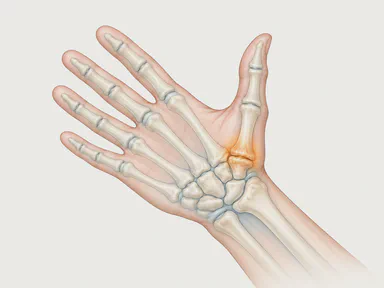
- Thumb base arthritis Pain and loss of strength at the base of the thumb caused by wear of the trapeziometacarpal joint.
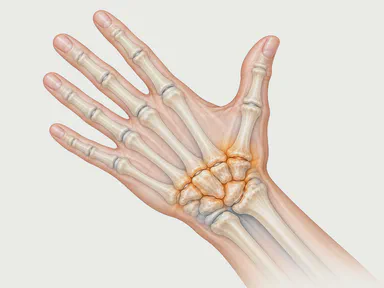
- Wrist osteoarthritis Wear of the wrist cartilage, almost always a consequence of an old fracture or ligament rupture, causing progressive pain and stiffness.
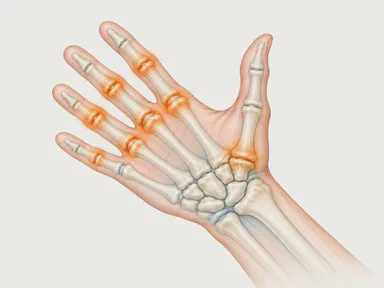
- Rheumatoid arthritis A chronic inflammatory disease affecting the joints and tendons of the hand, which can cause deformities and tendon ruptures that surgery helps to treat.
Sources and references
The information on this page is general and educational. It does not replace an individual medical assessment.
