

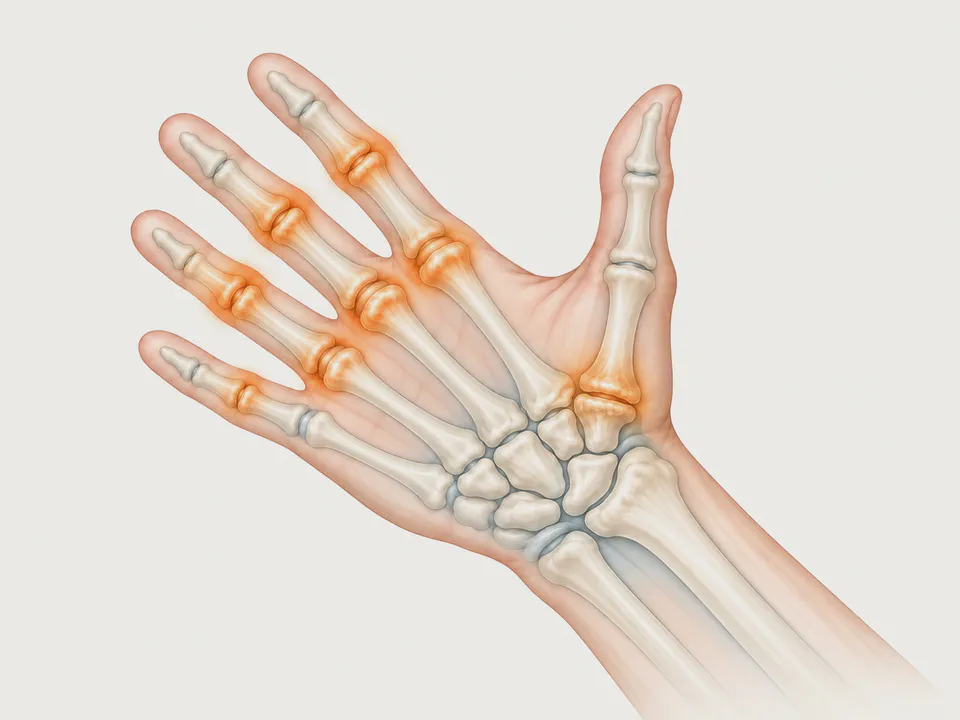
What is rheumatoid arthritis in the hand and wrist?
Rheumatoid arthritis is a chronic autoimmune disease in which the immune system attacks the synovial membrane, the tissue that lines the inside of joints and envelops the tendons. The inflamed synovium, or synovitis, causes pain and swelling and, over time, erodes cartilage, bone and ligaments, and can wear down tendons until they rupture.
The hand and wrist are the areas most frequently affected, and often the first to be affected. It is a systemic disease: it affects several joints at once, is usually symmetrical, and may be accompanied by fatigue and manifestations outside the joints. Its treatment is directed by the rheumatologist; the hand surgeon becomes involved when local problems appear that medication does not resolve.
Symptoms
- Pain and swelling of the knuckle joints, the middle joints of the fingers and the wrist, often in both hands.
- Prolonged morning stiffness, lasting more than half an hour.
- Soft thickening on the back of the wrist or fingers due to synovitis of the tendons.
- As the disease progresses, characteristic deformities: fingers drifting towards the little finger, swan-neck or boutonnière fingers, prominence of the ulnar head, and collapse of the wrist.
- Tendon rupture: sudden inability to straighten the little or ring finger, or to bend the tip of the thumb, without any injury.
- Tingling in the fingers due to compression of the median nerve, as synovitis of the carpal tunnel is common.
- Rheumatoid nodules under the skin, in areas of friction.
Causes and risk factors
The exact cause is not known. A genetic predisposition and environmental factors are involved, among which smoking is the best established. It is more common in women and usually starts between the ages of 30 and 60, although it can appear at any age. It is not caused by hand use or work.
The degree of damage to the hand depends mainly on disease control: current treatments, started early, have markedly reduced the severe deformities that were once common decades ago.
Diagnosis
Diagnosis of the disease is made by the rheumatologist, based on the examination, blood tests, with markers of inflammation and antibodies such as rheumatoid factor and anti-CCP antibodies, and imaging studies. In the hand surgery consultation, the examination assesses each joint and each tendon separately, the stability of the wrist and the state of the nerves. X-rays show the erosions and alignment, and ultrasound detects active synovitis and tendon ruptures before they become evident.
Treatment
The mainstay of treatment is medical: disease-modifying drugs, biological therapies and corticosteroids during flares, adjusted by the rheumatologist. With good control, many people never need hand surgery.
Locally, rest splints for the wrist and fingers help, as does occupational therapy to protect the joints during daily tasks, technical aids, and injections of corticosteroid into a specific joint or tendon sheath when inflammation persists despite general treatment.
When is surgery necessary?
Surgery is considered, always in coordination with the rheumatologist, when:
- synovitis of the wrist or tendons persists for months despite medical treatment and threatens to rupture the tendons;
- a tendon rupture has occurred, which does not recover on its own and may drag the neighbouring tendons with it;
- there is nerve compression with loss of sensation or strength;
- the pain from a destroyed joint cannot be controlled;
- a deformity prevents basic functions such as pinch or grip.
The goal is to relieve pain, prevent further damage and restore function, not to correct the appearance of the hand for its own sake.
Surgery for rheumatoid arthritis in the hand
The most common procedures are:
- Synovectomy and tenosynovectomy: removal of the inflamed synovium from the wrist, finger joints or tendon sheaths, to relieve pain and protect the tendons.
- Repair of tendon ruptures: as the ends are worn, tendon transfers or grafts are often used, within tendon surgery. Resection or stabilisation of the ulnar head that caused the wear is frequently carried out at the same time.
- Nerve decompression, such as carpal tunnel release, together with synovectomy of the flexors.
- Knuckle arthroplasty, with implants that realign the fingers and improve movement in hands with advanced deformity.
- Arthrodesis of the wrist or of specific finger and thumb joints, which eliminates pain and provides stability at the cost of fixing the joint.
Where possible, minimally invasive surgery approaches are used to reduce the impact on already fragile tissues.
Recovery
Recovery varies according to the procedure. After a synovectomy, the hand is mobilised early with a protective splint. After a tendon transfer, the tendon is protected for a few weeks and a rehabilitation programme follows to learn to use the new tendon. After an arthrodesis or arthroplasty, immobilisation and recovery take longer. Hand therapy is essential in all cases.
People with rheumatoid arthritis heal somewhat more slowly and have a slightly higher risk of infection, partly due to their medication. For this reason, the management of medication around surgery is agreed with the rheumatologist, and follow-up is shared. An important point explained before surgery is that the disease continues: surgery treats a specific problem, not the arthritis as a whole.
Specialist in rheumatoid arthritis of the hand in Barcelona
Dr Marta Martí Puente is a specialist in Orthopaedic Surgery and Traumatology with a focus on hand surgery and the wrist. At her consultation in Barcelona she assesses the manifestations of rheumatoid arthritis in the hand individually and in coordination with each patient’s rheumatologist, from splints and injections through to synovectomy, tendon repair or surgery for deformities when indicated.
Frequently asked questions
Who should treat my rheumatoid arthritis, the rheumatologist or the hand surgeon?
Does surgery cure rheumatoid arthritis?
Do I have to stop my medication before surgery?
I suddenly can't straighten my little finger. What could this be?
Related conditions
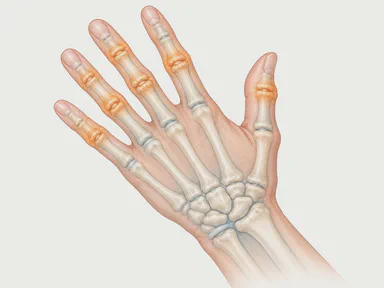
- Finger osteoarthritis Pain, stiffness and nodes in the finger joints caused by cartilage wear, especially in the joints closest to the nail.
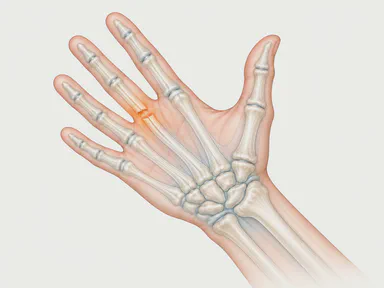
- Tendon injuries Cuts, ruptures and detachments of the tendons that move the fingers: from mallet finger to deep wounds requiring urgent repair.
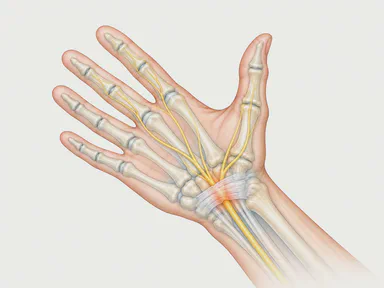
- Carpal tunnel Night-time tingling, numbness in the fingers and loss of strength caused by compression of the median nerve at the wrist.
Sources and references
The information on this page is general and educational. It does not replace an individual medical assessment.
