

The main difference lies in which structure hurts and how it started. Tendinitis is irritation of a tendon (the cord that connects muscle to bone) and tends to develop gradually from overuse, with pain on moving in a particular direction. A ligament injury affects the ligaments, which join the bones to one another, and almost always begins with a fall or a sudden twist; it hurts when loading the joint and can come with instability or clicking. The two are treated very differently, so confusing them delays recovery.
This article is a general guide. Only examination, and sometimes imaging, can tell for certain which of the two you have.
Tendons and ligaments: two different structures
To understand the difference, it helps to be clear on the anatomy:
- Tendons transmit force from muscle to bone. In the wrist they pass through tunnels or channels, particularly on the back and palm side, gliding within a sheath. When the tendon or its sheath becomes inflamed or degenerates, this is called tendinitis or tenosynovitis.
- Ligaments join the bones together and keep the wrist stable. The most clinically relevant ones are those joining the carpal bones to one another (such as the scapholunate ligament) and the triangular fibrocartilage complex on the ulnar side. Their injury is called a sprain if partial, and a rupture if complete.
Tendons are injured through use; ligaments, through force. That is the first clue.
How the pain starts
Tendinitis
The pain of tendinitis usually sets in over days or weeks, with no specific moment it began. It appears after a period of greater-than-usual activity: a new job, a newborn baby, a change of sport, long hours at the keyboard. De Quervain’s tenosynovitis is the most common example in the wrist, with pain on the thumb side.
Ligament injury
Here there is almost always an identifiable episode: a fall onto the hand, a forced twist of the forearm, a ball striking an outstretched hand. Pain and swelling appear immediately or within the following hours. Sometimes the episode seems minor and gets labelled a “sprain”, but if it is still hurting weeks later, a wrist ligament injury or TFCC injury should be suspected.
Where it hurts and what triggers it
| Feature | Tendinitis | Ligament injury |
|---|---|---|
| Location | Along the path of the tendon, often on the edge of the wrist | Inside the joint, on the back or ulnar side |
| What triggers it | Moving against resistance in a particular direction | Loading weight, leaning on the hand, rotating the forearm |
| Associated sensations | Pain on pressing the tendon, sometimes crepitus | Clicking, a sense of instability, the wrist “giving way” |
| Swelling | Localised over the tendon | Diffuse, within the joint |
| Movement | Preserved, although it hurts | Can be limited or painful at the end of the range |
These differences are a general guide: in practice there is overlap, and it is not uncommon for both to coexist, for example tendinitis of the ulnar-sided tendons alongside a TFCC injury.
How each one is confirmed
In clinic, examination aims to reproduce the pain selectively. For tendons, stretching and resisted contraction manoeuvres of the suspected tendon are used; for ligaments, stability tests that shift one bone relative to another or load the joint in a particular direction.
Imaging tests are chosen according to the suspicion:
- Ultrasound shows tendons, their sheath and surrounding fluid very well, and allows movement to be seen in real time.
- X-ray does not show ligaments, but does show the consequences of their rupture: abnormal separation between bones or loss of alignment. Sometimes views are taken with the hand clenched into a fist to make this more apparent.
- MRI allows ligaments and fibrocartilage to be seen, although it does not detect every injury.
- Wrist arthroscopy is what shows the ligaments directly and allows them to be treated in the same procedure when the injury requires it.
Why telling them apart matters: treatment
Tendinitis is treated, in most cases, with relative rest, a splint, adapting activity, anti-inflammatories if indicated, and an injection when it does not improve. Only a minority of stubborn cases need tendon surgery, generally to release the channel the tendon passes through.
A partial ligament injury can be treated with several weeks of immobilisation, followed by proprioception and strengthening exercises. However, a complete rupture of a major ligament does not heal on its own, and if left to run its course the wrist becomes unstable and can develop osteoarthritis over the years. In these cases, repair or reconstruction of the ligament is considered, often by arthroscopy, with better results the sooner it is carried out.
In other words: treating a ligament rupture as though it were tendinitis means applying, for months, a treatment that cannot work, while the injury loses options for repair. And conversely, immobilising for weeks a case of tendinitis that only needed its activity adjusted causes unnecessary stiffness.
Warning signs pointing to a ligament
If, after a twist or a fall, you notice any of the following, a specific assessment is worthwhile:
- pain that persists for more than three or four weeks despite rest;
- clicking or a sensation that the wrist “gives way” with certain movements;
- pain when leaning on the hand to stand up, or doing press-ups;
- a clear loss of grip strength;
- swelling on the back of the wrist that does not settle.
When should you see a specialist?
See a specialist if the wrist pain does not improve within two or three weeks of relative rest, if it started with a fall or a sudden twist, if you notice instability or clicking, or if you have lost strength. The sooner a ligament injury is identified, the more straightforward its treatment tends to be.
You can find out more on the page about wrist ligament injuries and on the De Quervain’s tenosynovitis and TFCC injury pages linked above. For an assessment with Dr Marta Martí Puente, hand and wrist surgeon in Barcelona, you can get in touch via the contact page.
Frequently asked questions
How do I know if my wrist pain is from a tendon or a ligament?
Can a wrist sprain be a serious ligament injury?
Which test tells tendinitis apart from a ligament injury?
Related conditions
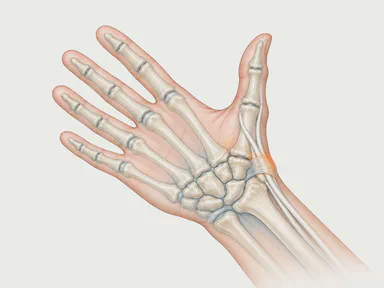
- De Quervain's Pain on the thumb side of the wrist when pinching, rotating or lifting weight, caused by irritation of the sheath around the thumb tendons.
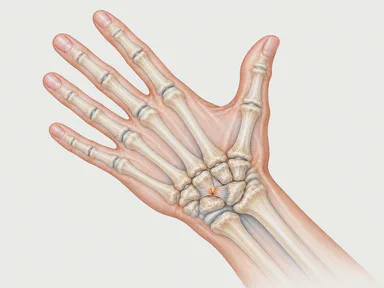
- Wrist ligaments Sprains and ruptures of the ligaments joining the carpal bones, especially the scapholunate ligament, which can destabilise the wrist and lead to osteoarthritis.
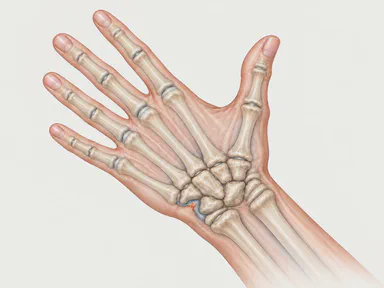
- TFCC injury A frequent cause of pain on the little-finger side of the wrist, with clicking when rotating the forearm, after a fall or due to wear.
Sources and references
The information on this page is general and educational. It does not replace an individual medical assessment.
