

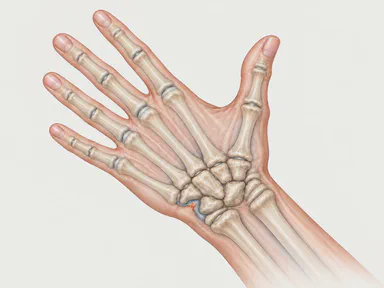
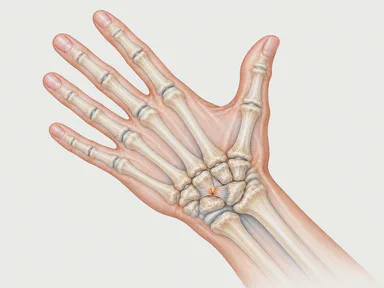
The TFCC, short for triangular fibrocartilage complex, is a set of ligaments and a cartilage disc located on the little-finger side of the wrist, between the end of the ulna and the carpal bones. A TFCC injury is a tear or wearing down of this structure, and it mainly presents as pain on the ulnar border of the wrist when rotating the forearm, putting weight on the hand, or loading it. It is one of the most common causes of wrist pain “on the little-finger side” that does not improve with time.
Below we explain what this structure does, how it is injured, and how it is diagnosed and treated, always as general information.
What it is and what it does
The triangular fibrocartilage has two main functions:
- Cushioning the load that passes from the hand towards the ulna. When you put your hand on a table or do a push-up, part of the force passes through this structure.
- Stabilising the distal radioulnar joint, the one that allows the forearm to rotate to turn the palm up or down. Its ligaments keep the ulna and radius joined together during that rotation.
That is why, when the TFCC is injured, symptoms appear precisely when rotating the forearm, putting weight on the hand, and gripping with the wrist turned towards the little finger.
How it is injured
There are two broad types of triangular fibrocartilage injury.
Traumatic injuries
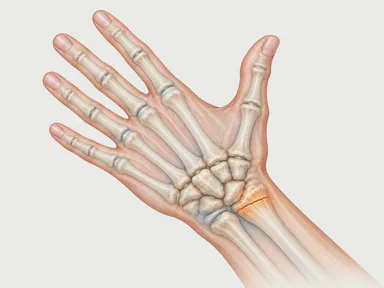
These occur after a fall onto an outstretched hand, a sudden twist of the forearm (for example, with a drill that jams, or a racquet), or a strong pulling force. They often accompany a distal radius fracture, and are sometimes the reason why a wrist continues to hurt on the ulnar side once the fracture itself has healed.
Degenerative injuries
These appear through progressive wear, without a specific injury. The most common factor is that the ulna is slightly longer than the radius, which means the disc is compressed with every movement. Over time it thins and can perforate. These injuries are more common from middle age onwards and in people who perform repeated twisting and loading movements.
Symptoms
The most common symptoms are:
- pain on the edge of the wrist, on the little-finger side, just below the end of the ulna;
- pain when turning the hand, for example opening a door handle, turning a key or using a screwdriver;
- discomfort when leaning on the hand to get up from a chair or doing floor exercises;
- clicking or a “click” sensation with movement;
- loss of grip strength;
- in some cases, a feeling that the ulna is “loose” or that the wrist is not stable.
The pain can be mild at first and lead to it being dismissed as a minor sprain. When it is still there weeks later and appears with the same movements, a TFCC injury should be suspected.
How it is diagnosed
Examination is the first tool: the point of pain is located, the stability of the distal radioulnar joint is checked, and manoeuvres are performed that reproduce the symptoms by loading the wrist towards the ulnar side. These manoeuvres also help to distinguish a TFCC injury from other wrist ligament injuries or from tendinitis of the ulnar-sided tendons, which cause pain in a very nearby area.
An X-ray allows the relative length of the ulna to be measured and rules out fractures or osteoarthritis. MRI, sometimes with intra-articular contrast, is the most useful imaging test for seeing the fibrocartilage, although it has limitations: not every tear is detected, and some doubtful images do not correspond to injuries that actually cause symptoms. For this reason, when doubt remains or treatment is being considered, wrist arthroscopy remains the gold standard: it allows the TFCC to be seen directly and its tension and attachment to be assessed.
Treatment
In many injuries, particularly if they are recent and there is no instability, treatment starts with a conservative approach: a splint or cast that limits forearm rotation for several weeks, relative rest, anti-inflammatories if indicated, and afterwards progressive exercises. Some injuries settle this way and need nothing further.
When pain persists, there is instability, or the injury is of a type that does not heal on its own, arthroscopic surgery is considered. Through two or three millimetre-sized incisions a camera is introduced, and, depending on the case, three things can be done: debriding the torn area if it is a central injury, reattaching or suturing the fibrocartilage if it has come away from its anchor point, and, in degenerative injuries with a long ulna, shortening the ulna to unload the area. This last option is carried out through open surgery, combined with arthroscopy when needed.
Recovery depends on the type of procedure: after debridement it tends to be quicker, while after reattachment or shortening, several weeks of immobilisation and subsequent rehabilitation are needed. The specific timeframes are explained before surgery and adjusted for each person.
When should you see a specialist?
If you have had pain on the ulnar border of the wrist for more than a few weeks, particularly if it appears when rotating the forearm or putting weight on the hand, if you notice clicking or loss of strength, or if the little-finger side still hurts after a wrist fracture, a specific assessment is worthwhile. A TFCC injury diagnosed in time has more options for straightforward treatment.
You will find more detailed information on the TFCC injury page. If you would like Dr Marta Martí Puente, who focuses on wrist surgery in Barcelona, to assess your case, you can request an appointment via the contact page.
Frequently asked questions
Does a TFCC injury heal on its own?
What test detects a TFCC injury?
Can I have a TFCC injury without having fallen?
Related conditions
- TFCC injury A frequent cause of pain on the little-finger side of the wrist, with clicking when rotating the forearm, after a fall or due to wear.
- Wrist ligaments Sprains and ruptures of the ligaments joining the carpal bones, especially the scapholunate ligament, which can destabilise the wrist and lead to osteoarthritis.
- Distal radius fracture The most common wrist fracture: it occurs on falling onto an outstretched hand and can be treated with a cast or with surgery depending on the displacement.
Sources and references
The information on this page is general and educational. It does not replace an individual medical assessment.
