

Yes, tingling in the fingers is the most typical symptom of carpal tunnel syndrome, but not every case of tingling is carpal tunnel. The main clue lies in which fingers go numb and when: carpal tunnel syndrome affects the thumb, index finger, middle finger and half of the ring finger, and tends to worsen at night or when the wrist is held bent. If the tingling is concentrated in the little finger, spreads up the whole arm, or appears in both hands and the feet, other causes need to be considered.
What follows is general information to help you interpret what you are noticing. It does not replace examination by a professional.
What carpal tunnel tingling feels like
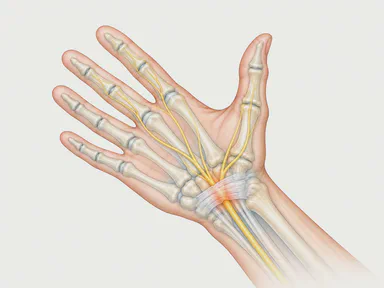
Carpal tunnel syndrome occurs when the median nerve becomes compressed as it passes through the wrist. As this nerve carries sensation from the palm side of the thumb, index finger, middle finger and half of the ring finger, the tingling is located in those fingers. It typically presents as follows:
- At night or on waking, with a need to shake the hand to ease the sensation.
- During sustained postures: driving, holding a phone, reading or talking on the phone.
- With associated clumsiness: dropping small objects, difficulty doing up buttons.
- Sometimes with pain that travels from the wrist up towards the forearm.
In the early stages the tingling comes and goes. As the compression progresses, the “pins and needles” feeling becomes more constant, and loss of strength in the thumb can appear.
When the tingling points to another cause
Tingling in the little finger and ring finger
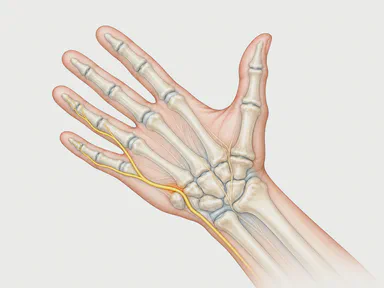
These two fingers depend on the ulnar nerve, not the median nerve. If they are the ones going numb, the compression is usually at the elbow (where the nerve passes through the cubital tunnel) or, less often, at the wrist, in Guyon’s canal. In this second case there can also be weakness when spreading the fingers apart.
Tingling that travels down from the neck
Compression of a nerve root in the cervical spine can cause tingling in the hand, but it is usually accompanied by pain in the neck or shoulder, follows a band down the arm, and changes with head movements. Here, wrist manoeuvres do not reproduce the symptoms.
Tingling in both hands and the feet
When the tingling is symmetrical and also affects the feet, the most likely explanation is polyneuropathy, that is, a diffuse disorder of the nerves, for example due to diabetes, vitamin B12 deficiency, alcohol or certain medications. This requires a different approach, generally from internal medicine or neurology.
Other situations
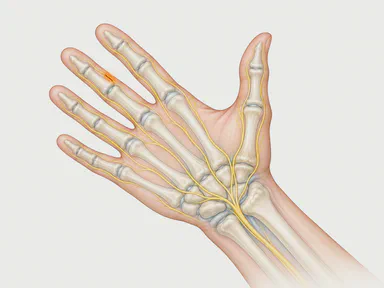
Nerve injuries of the hand following a cut or trauma, anxiety with hyperventilation, or circulation changes such as Raynaud’s phenomenon can also cause tingling, each with its own pattern.
Factors that make carpal tunnel syndrome more likely
Carpal tunnel syndrome is more common in women, between the ages of 40 and 60, and in people with repetitive manual work. It is also made more likely by pregnancy, diabetes, an underactive thyroid, rheumatoid arthritis, being overweight, and the after-effects of a wrist fracture. None of these factors confirms the diagnosis on its own, but they help gauge how likely it is.
How it is confirmed
The diagnosis rests mainly on the clinical history and examination. The exact distribution of the tingling is checked, provocation manoeuvres are used to look for signs of compression (such as flexing the wrist for a minute or tapping over the nerve), and the strength and bulk of the thumb muscles are assessed.
When there is doubt, or before considering surgery, an electromyogram is requested, which measures the speed of nerve conduction and allows the compression to be graded. Ultrasound can show thickening of the nerve and rule out cysts or other causes of compression at the wrist. If a cervical origin is suspected, the investigation is directed towards the spine.
What can be done
In mild cases, a night splint that keeps the wrist straight, adapting activities and, if indicated, an injection can control the symptoms. When the tingling is daily, there is loss of sensation or strength, or the electromyogram shows moderate or severe compression, carpal tunnel release is considered, a brief, day-case procedure. Other nerve compressions of the hand and forearm are treated as part of peripheral nerve surgery.
One important point: a nerve that has been compressed for a long time recovers less well. The aim is not to operate early as a matter of routine, but not to let months go by with a numb hand and no diagnosis.
When should you see a specialist?
See a specialist if the tingling recurs several nights a week, if you notice that sensation in the fingers is not fully returning, if you are dropping objects, or if you see that the base of the thumb has lost bulk. Also if the pattern does not fit with carpal tunnel syndrome, because other nerve compressions also benefit from an early diagnosis.
You can find more information on the carpal tunnel syndrome page and, if your case is different, on the pages about Guyon’s canal and nerve injuries of the hand linked above. For a personalised assessment with Dr Marta Martí Puente in Barcelona, you can get in touch via the contact page.
Frequently asked questions
Which fingers go numb in carpal tunnel syndrome?
Is tingling in the little finger carpal tunnel syndrome?
Do I need an electromyogram to find out if I have carpal tunnel syndrome?
Related conditions
- Carpal tunnel Night-time tingling, numbness in the fingers and loss of strength caused by compression of the median nerve at the wrist.
- Guyon's canal Tingling in the ring and little fingers and loss of hand strength caused by compression of the ulnar nerve at the wrist.
- Nerve injuries Section, compression or neuroma of the median, ulnar, radial or digital nerves, with loss of sensation or strength that may require microsurgery.
Sources and references
The information on this page is general and educational. It does not replace an individual medical assessment.
