

Pain at the base of the thumb that appears when pinching, turning a key, opening a jar or wringing out a cloth is, in people from middle age onwards, the most characteristic symptom of thumb base arthritis (rhizarthrosis), wear of the joint that connects the thumb to the wrist. It is not the only possible cause of pain in that area, but it is one of the most common, and recognising its features helps you know when it is worth seeking advice.
This article offers general information. Diagnosis requires an examination and, in most cases, an X-ray.
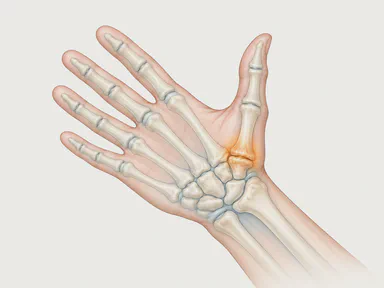
Which joint hurts in thumb base arthritis
The base of the thumb rests on a small carpal bone called the trapezium. The trapeziometacarpal joint is the one that allows the thumb to oppose the other fingers and form a pinch grip. It is a very mobile joint, and precisely because of this it bears a great deal of load during everyday movements. Over the years, the cartilage covering it can wear down, and that wear is thumb base arthritis.
It is more common in women from around 50 years of age onwards, although it also occurs in men and in younger people, particularly if there was a previous fracture or ligament injury in that area.
Symptoms that suggest it
Pain when pinching and gripping
The first symptom is usually pain at the base of the thumb, where it joins the wrist, which appears during pinching movements: picking up a plate, holding a book, writing for a while, turning a door handle. At first it is a pain that comes and goes with activity; over time it can also appear at rest or at night.
Loss of pinch strength
Many people say they “can no longer open jars” or struggle to wring out clothes. This loss of strength is a consequence of the pain and the joint wear, and tends to come with a sense of instability.
Stiffness and clicking
When moving the thumb, cracking or a grating sensation may be noticeable. Mobility for moving the thumb away from the palm gradually becomes more limited.
Deformity in advanced stages
As the arthritis progresses, the base of the thumb can protrude outward and the thumb takes on a “Z-shaped” appearance, with the next joint hyperextending to compensate. This deformity occurs late and not everyone reaches this stage.
What it can be confused with
The area at the base of the thumb is small, and several structures can cause pain there:
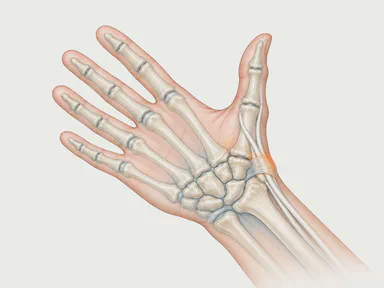
- De Quervain’s tenosynovitis: the pain sits a little further up, on the edge of the wrist, over the thumb tendons, and worsens when tilting the hand towards the little finger with the thumb tucked inside the fist. It is typical of new mothers and of repetitive work. More information on the De Quervain’s tenosynovitis page.
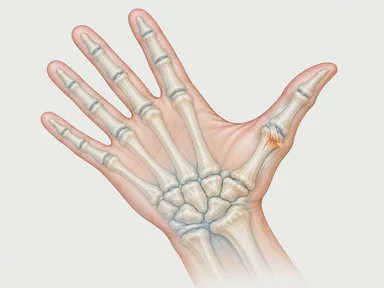
- Thumb ligament sprain: there is usually a clear injury, such as a fall while skiing or onto an open hand, and the pain is in the next joint along, the one that forms the thumb knuckle. We explain this on the thumb sprain page.
- Arthritis of other carpal joints, such as the one between the scaphoid, the trapezium and the trapezoid, which causes very similar pain and sometimes coexists with thumb base arthritis.
Examination allows the painful point to be located precisely and the pain reproduced with specific manoeuvres. A simple X-ray confirms the wear and its degree, and helps distinguish it from the other causes.
How it is treated
Treatment is staged and always starts with conservative measures:
- A splint that stabilises the base of the thumb, worn at night or during the activities that hurt the most.
- Adapting movements: avoiding strong, sustained pinching, using thick-handled utensils, sharing the load between both hands.
- Exercises for gentle strengthening of the thumb muscles, guided by a physiotherapist or occupational therapist specialising in the hand.
- Anti-inflammatory medication for short periods, if indicated.
- Injection into the joint, which can relieve symptoms for weeks or months in early or intermediate stages.
When pain limits daily life despite all this, surgery is considered. Several techniques exist depending on the degree of arthritis, age and each person’s demands, ranging from arthroscopic or minimally invasive surgery procedures in early stages to removal of the trapezium with ligament reconstruction or joint replacement in advanced stages. The choice is explained at the consultation, along with its advantages and limitations, because there is no single technique suited to every case.
When should you see a specialist?
It is worth seeking advice if pain at the base of the thumb recurs for more than a few weeks, if you have lost strength for everyday movements, if you notice deformity, or if the pain wakes you at night. There is no need to wait until the arthritis is advanced: in early stages conservative measures work better and there are more options.
You will find a fuller explanation on the thumb base arthritis page. If you would like Dr Marta Martí Puente to assess your thumb at her hand surgery practice in Barcelona, you can request an appointment via the contact page.
Frequently asked questions
Does thumb base arthritis always need surgery?
Can thumb base arthritis be prevented?
Can pain at the base of the thumb be something else?
Related conditions
- Thumb base arthritis Pain and loss of strength at the base of the thumb caused by wear of the trapeziometacarpal joint.
- De Quervain's Pain on the thumb side of the wrist when pinching, rotating or lifting weight, caused by irritation of the sheath around the thumb tendons.
- Thumb sprain Pain and instability at the base of the thumb after a fall or sudden pull, caused by injury to the ulnar collateral ligament of the metacarpophalangeal joint.
Sources and references
The information on this page is general and educational. It does not replace an individual medical assessment.
